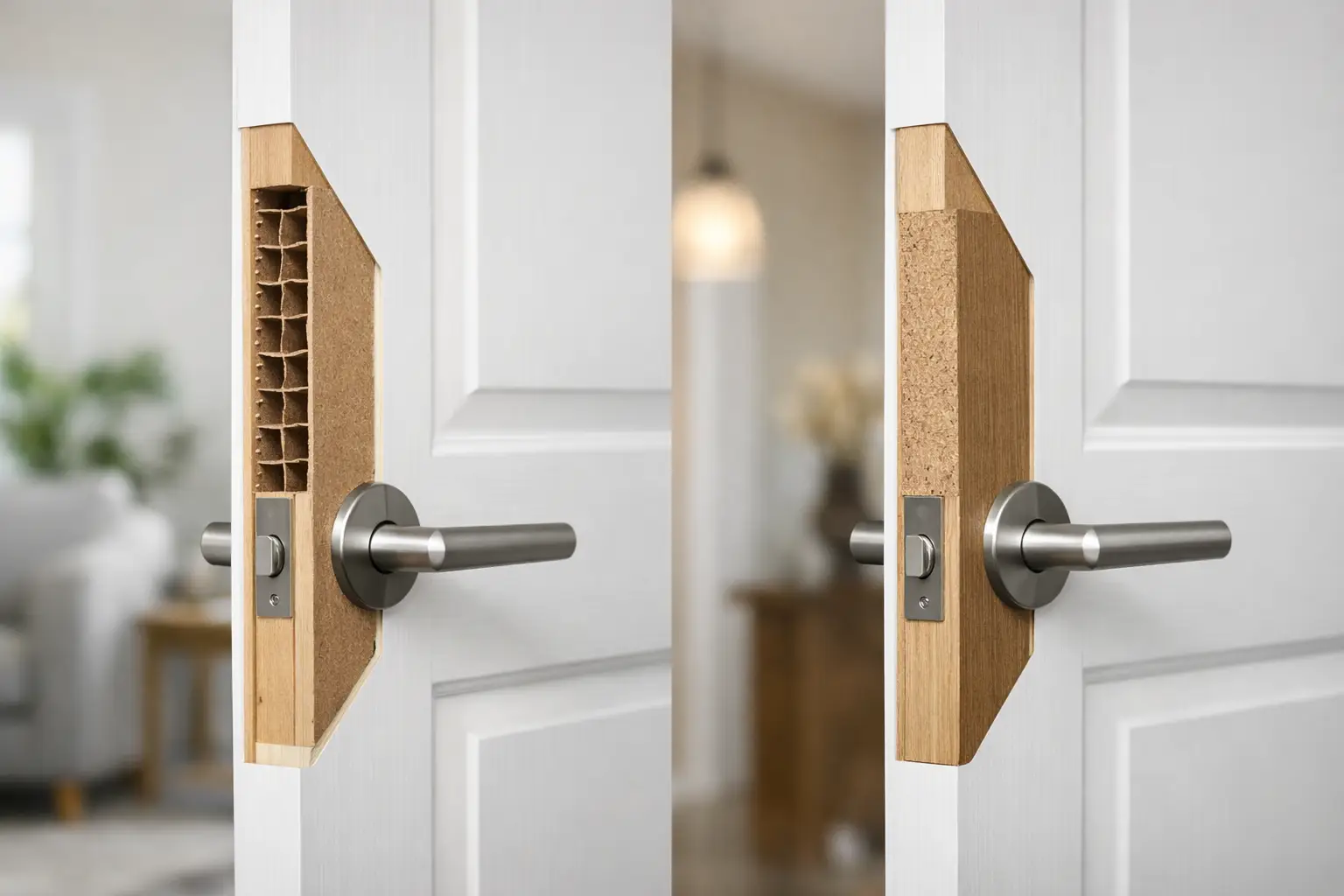
A beautiful primary suite loses some of its comfort when every conversation, television show, and early-morning shower carries through a lightweight bedroom door. Interior doors are often treated as a late-stage finish selection, but hollow-core vs. solid-core interior doors can affect privacy, daily comfort, design quality, and a renovation budget long after construction is complete.
For a Los Angeles home remodel, the right answer is rarely “use the same door everywhere.” A door serving a guest closet has different demands than one separating a home office from an active family room or a primary bedroom from a hallway. Understanding where each construction type performs best helps you invest where it will be noticed most.
Hollow-Core vs. Solid-Core Interior Doors: The Basic Difference
A hollow-core door is typically made with a thin wood, MDF, or hardboard skin over a lightweight internal framework. The center is not completely empty. It commonly contains a honeycomb cardboard grid or small wood blocks that help the door hold its shape. This construction keeps the door light and affordable, but it does little to stop sound.
A solid-core door has a dense engineered wood or composite core beneath its finished surface. It is not necessarily a solid slab of natural hardwood, despite the name. The dense core gives it more weight, a firmer feel, and substantially better acoustic performance than a hollow-core option.
Both types can be finished in many styles. They may be smooth, shaker-style, flush, molded, painted, stained, or fitted with glass panels. From across the room, a well-finished hollow-core door can look much like a solid-core door. The difference becomes obvious when you open, close, or live with it.
The Daily Difference: Sound, Feel, and Privacy
Sound control is usually the deciding factor. Hollow-core doors allow a surprising amount of noise to pass through, particularly voices, television sound, children playing, and the mechanical hum of a laundry area. They are generally acceptable for closets, pantries, and low-priority storage areas, but they can feel insufficient in a home where people work remotely, entertain often, or keep different schedules.
Solid-core doors reduce transmitted sound because their added mass resists vibration. They will not make a room fully soundproof on their own. Gaps at the door perimeter, an undercut at the floor, shared walls, HVAC ducts, and the condition of the frame all affect results. Still, a properly installed solid-core door is one of the most practical upgrades for improving bedroom, office, and bathroom privacy.
The closing action also matters. A hollow-core door can feel light and slightly resonant. Solid-core doors close with a more substantial, controlled feel that complements higher-end cabinetry, flooring, and trim. In a carefully designed renovation, that tactile difference contributes to the overall sense of workmanship.
Where Hollow-Core Doors Make Sense
Hollow-core doors are not automatically a poor choice. They are a reasonable fit when budget is limited, sound separation is not important, and the door will receive light use. A linen closet, utility closet, pantry, secondary storage room, or low-traffic rental unit may not justify the cost of a heavier door.
Their lighter weight also makes them easier to handle during installation and easier on older or lighter-duty hinges. When replacing a door only, without changing the frame, hardware, or casing, a hollow-core slab can simplify the work.
That said, homeowners should think beyond the initial purchase price. Replacing hollow-core doors later can require new casing, paint touchups, hardware changes, and disruption to finished spaces. If a full-home renovation is already underway, it is often more cost-effective to make the right door choice before final paint and trim are complete.
Where Solid-Core Doors Are Worth the Upgrade
Solid-core doors are especially valuable at bedroom entries, bathrooms, home offices, nurseries, media rooms, and laundry rooms. These are spaces where a little separation makes a meaningful difference every day.
They are also a strong choice for a primary suite. In many Los Angeles homes, the primary bedroom functions as a retreat, workspace, dressing area, and sleeping space. A solid-core door helps the suite feel more private without changing the layout or adding expensive sound-control assemblies inside the walls.
For luxury homes, custom builds, and major renovations, solid-core doors are often the appropriate baseline for principal living areas. They support the quality level clients expect from upgraded millwork, concealed hinges, premium lever hardware, and carefully detailed casing.
Solid-core doors can also be a smart upgrade in condos, townhomes, and homes with multigenerational living arrangements. When occupants are close together, privacy is not simply a convenience. It improves how comfortably the home works for everyone.
Cost Is More Than the Door Slab
Hollow-core doors cost less than solid-core doors, sometimes by a meaningful amount when a project includes many openings. However, the full installed cost deserves closer attention. Solid-core doors weigh considerably more and may require sturdier hinges, more careful frame adjustment, and skilled installation to prevent sagging, rubbing, or uneven reveals.
A heavier door also needs appropriate hardware. Standard hinges may be inadequate for a tall, wide, or particularly heavy solid-core slab. The number of hinges, hinge grade, jamb condition, and fastening into framing all matter. A door that is premium on paper but poorly hung will not operate like a premium door.
Door style affects pricing as well. A simple flush painted door is generally less expensive than a custom-profile shaker door, a paint-grade routed design, or a veneer door with a stained finish. Glass inserts, oversized heights, pocket-door systems, and concealed hardware can further change the budget.
The practical approach is to allocate solid-core doors to rooms where performance matters and use hollow-core doors selectively where they will not compromise the experience of the home. This can preserve budget for other high-value details, such as upgraded trim profiles, quality hardware, improved lighting, or better bathroom finishes.
Installation Details That Affect Performance
A door is only as good as its installation. Even a dense solid-core door can allow sound and light through if the jamb is out of square, the latch does not pull the door tight, or the perimeter gaps are excessive.
For bedrooms, offices, and bathrooms, consistent reveals and a properly sized door bottom are essential. If sound privacy is a priority, consider a door sweep or acoustic perimeter seals where appropriate. These details should be selected carefully, especially in bathrooms or areas that need adequate ventilation and clearance from flooring.
The type of door operation matters, too. Swing doors generally provide better privacy than barn doors because they close against stops on all sides. Pocket doors are useful when space is tight, but they typically offer less sound control than a hinged solid-core door unless the system and seals are specifically designed for acoustic performance.
During a renovation, door selections should be coordinated early with flooring thickness, casing design, wall finishes, hardware locations, and electrical switches. This prevents common problems such as doors that scrape new flooring, levers that conflict with trim, or frames that need adjustment after paint is complete.
Choosing the Right Door for Your Renovation
Start by considering what happens on each side of the door. If the room needs quiet, privacy, or a more substantial finish, solid-core is usually the better investment. If the opening serves simple storage or a low-impact utility space, hollow-core can be a practical budget choice.
Also consider the home as a whole. Mixing door types is completely acceptable when it is intentional, but principal doors should not feel noticeably lighter or lower quality than the surrounding renovation. Matching the face style, paint color, casing, and hardware can create visual consistency while allowing the construction type to vary by room.
At Precise Building & Restoration, we help homeowners coordinate door selections with layout changes, trim details, hardware, flooring, and the broader construction plan. The goal is not to specify the most expensive option at every opening. It is to select materials that perform well, look polished, and support how your household actually lives.
A well-chosen interior door is a small daily luxury: it closes quietly, protects a private moment, and makes the finished home feel considered from room to room. For guidance on door selections as part of a Los Angeles remodel or custom build, call Precise Building & Restoration at 310-606-2222.