A private backyard should feel like an extension of your home, not a stage shared with neighboring windows, second-story balconies, or a busy street. Backyard privacy ideas: walls, screens, plants, pergolas, and placement all work best when they are planned around the exact sightlines you want to control. The right solution protects comfort without making the yard feel boxed in, dark, or overbuilt.
For Los Angeles homeowners, privacy design also needs to account for lot lines, hillside conditions, coastal weather, neighborhood character, and local permitting rules. A beautiful barrier is only successful if it fits the property, meets code requirements, and supports the way you actually use the space.
Start With Sightlines, Not a Fence Catalog
The most common mistake is choosing a privacy material before identifying where the exposure comes from. Stand in the patio, pool area, outdoor kitchen, and seating zones at the times you expect to use them. Then look outward and upward. A ground-level neighbor may be easy to screen with planting, while a nearby second floor may require a taller, more targeted solution.
Privacy is rarely an all-or-nothing condition. You may only need to block one corner of a dining patio, soften a view toward an adjacent driveway, or create seclusion around a spa. Targeted screening often looks more refined and costs less than enclosing every property edge with the same structure.
Placement matters just as much as height. A screen installed close to a lounge area can block an unwanted view with a shorter panel. Moving a seating area several feet, rotating an outdoor dining table, or placing a pergola between the house and a neighboring view can solve the problem without an oversized wall. This is where an early site plan and CAD concept can prevent expensive changes later.
Walls Create the Strongest Privacy Boundary
A solid wall offers the most reliable visual separation and can also reduce some street noise. Masonry, stucco-finished block, stone veneer, board-formed concrete, and finished wood systems each create a different architectural effect. The best material should relate to the home rather than look like an afterthought at the property line.
A low retaining wall topped with a lighter privacy element is often more elegant than one imposing structure. For example, a concrete or masonry base can handle grade changes, while horizontal slats or decorative metal panels above maintain airflow and visual interest. This approach can be especially useful on sloped properties, where drainage and structural engineering need to be resolved before finishes are selected.
Walls also come with the greatest responsibility. Height limits, zoning requirements, property-line conditions, retaining-wall rules, and utility locations can affect what is possible. In many cases, a wall that appears simple involves foundations, drainage, waterproofing, engineering, and permits. Never assume an existing fence or wall can be raised without review, particularly when it supports soil or sits near a hillside.
Use Screens for Privacy Without Closing Off the Yard
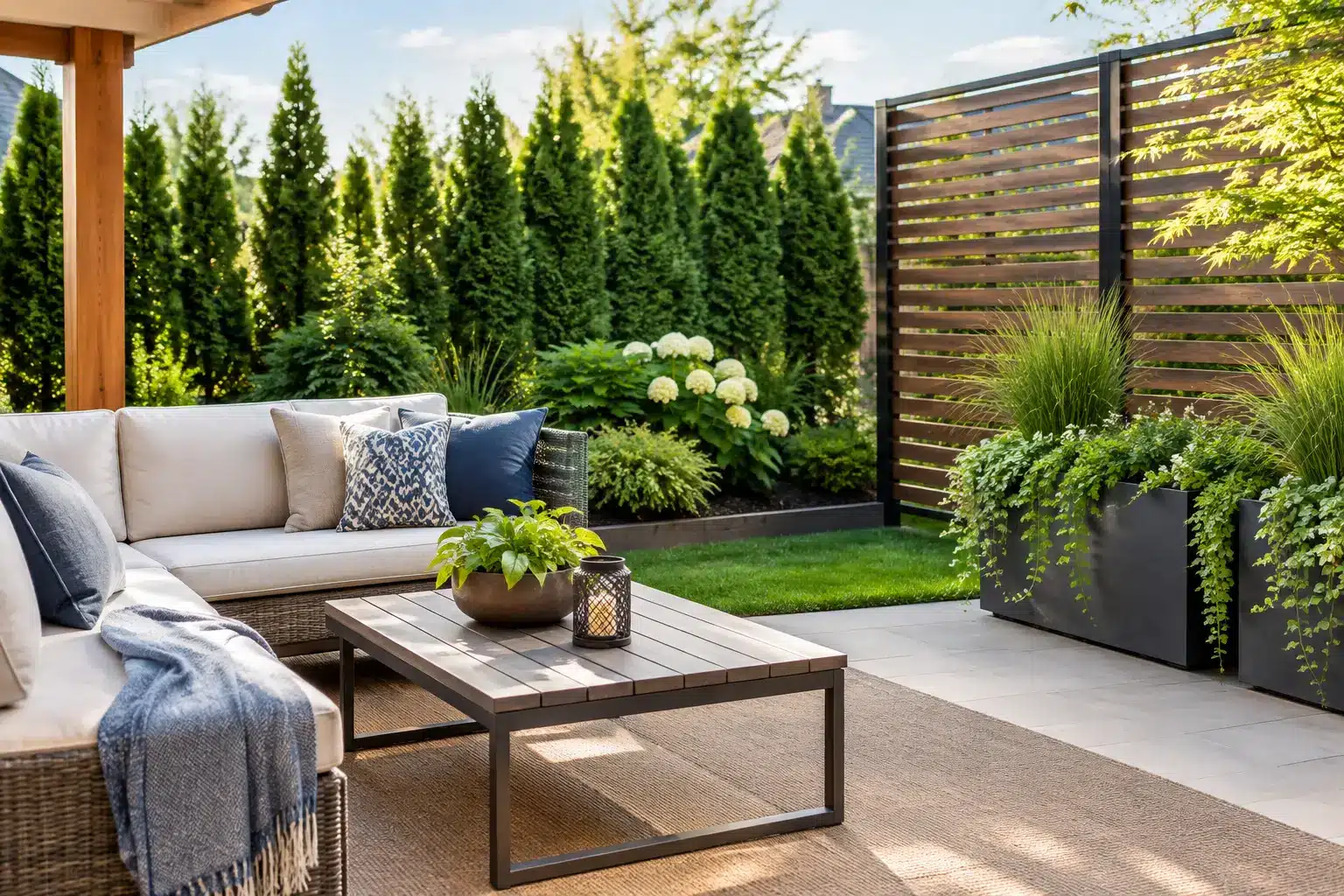
Architectural screens are a strong choice when you need privacy but still want light, breezes, and a sense of openness. They can be freestanding, attached to a wall, incorporated into a gate, or used as one side of a covered patio. Wood battens, powder-coated aluminum slats, laser-cut metal, composite cladding, and frosted glass all offer different levels of concealment.
Horizontal slats create a clean contemporary appearance and work well with modern remodels. Vertical battens can make a narrow yard feel taller and help break up a long boundary. Decorative metal screens add visual texture, but the pattern must be evaluated from both sides. A panel that looks opaque in a showroom may reveal more than expected when backlit at night.
Screens are also useful for defining outdoor rooms. A partial screen near an outdoor kitchen can conceal a service area. A pair of panels can create a more private path to a pool or ADU. Around a spa, a carefully placed screen gives users privacy while preserving an open view in the preferred direction.
Because screens catch wind, their posts and footings need proper design. This is not a place to rely on lightweight hardware or surface-mounted posts without evaluating the substrate. Quality installation keeps panels straight, secure, and quiet over time.
Plants Bring Softness, but They Need Time and Care
Living privacy is hard to match for warmth and natural beauty. Layered planting can soften a wall, screen upper-level views, absorb glare, and make a compact yard feel more established. It is also an excellent complement to structural privacy elements, especially where a fully solid boundary would feel heavy.
For year-round screening, use mostly evergreen material rather than relying on seasonal foliage. Clumping bamboo, podocarpus, ficus, pittosporum, and certain hedge varieties may work in Southern California, but the correct selection depends on sun exposure, irrigation, root behavior, mature size, and maintenance expectations. A plant that is attractive at installation can become a drainage, root, or trimming problem if it was chosen without enough room to grow.
Bamboo deserves particular caution. Clumping varieties are generally more manageable than running varieties, but every installation should consider containment, spacing, and long-term access for pruning. Tall hedges require ongoing care, and a narrow side yard may not give mature plants the soil volume they need.
A practical approach is to combine immediate and long-term privacy. Install a well-designed screen or wall for day-one coverage, then add planting to soften the architecture as it matures. This avoids waiting years for a hedge to perform while creating a layered, finished landscape from the start.
Pergolas Provide Overhead Privacy Where It Counts
Backyard privacy is not always a side-to-side issue. Many homes are overlooked from above, especially on properties near hillsides or multi-story residences. A pergola can create a protected feeling over an outdoor dining area, lounge, or kitchen while adding shade and a clear sense of destination.
Traditional open rafters provide limited privacy from upper windows. For more coverage, consider adjustable louvers, closely spaced slats, a solid roof section, or a combination of a pergola and side screens. The right choice depends on whether sun control, rain protection, airflow, or view preservation is the primary goal.
A pergola also needs to be designed as part of the home. Post placement affects circulation. Roof projection affects shade. Electrical planning affects fans, heaters, lighting, and speakers. If the structure attaches to the house, flashing and water management matter as much as appearance. A beautiful covered patio should not create future leak risks or make access to doors and windows difficult.
Backyard Privacy Ideas Need a Layered Plan
The most successful backyard privacy ideas use walls, screens, plants, pergolas, and placement together rather than depending on one oversized feature. A low wall may establish the boundary, a planted hedge may add softness, and a pergola may protect the exact seating area where privacy matters most. The result feels intentional instead of defensive.
Consider daytime and nighttime conditions separately. During the day, a slatted screen may block a direct view effectively. At night, bright interior or patio lighting can turn a partially open screen into a silhouette. Downlighting, shielded fixtures, dimmers, and careful placement of fire features can improve privacy after dark without sacrificing a welcoming atmosphere.
Also think about maintenance from the beginning. Wood needs finishing and periodic inspection. Metal needs appropriate coatings near coastal areas. Planting needs irrigation, pruning access, and a realistic care plan. A durable design is one that continues to look polished several years after the project is complete.
For a backyard transformation, the goal is not to build the tallest barrier possible. It is to create a setting where you can relax, entertain, and use every part of the property with confidence. Precise Building and Restoration can help plan privacy features within a complete backyard design, from early CAD concepts and permitting through construction and final finishes. Call 310-606-2222 to discuss a backyard layout that protects your privacy while preserving the light, flow, and character of your home.