A beautiful cabinet door can hide a poor cabinet box. When homeowners ask, “Plywood vs. MDF cabinets: which material is better for a Los Angeles kitchen?” the honest answer is that the right choice depends on where the material is used, how the cabinets are built, and the finish you want. Plywood and MDF each have legitimate strengths. The costly mistake is treating them as interchangeable.
For most kitchen remodels, we recommend evaluating cabinet boxes, doors, drawer fronts, shelves, and panels separately. A well-built kitchen often uses more than one material for a reason: plywood where structural strength and moisture resistance matter, and MDF where a smooth painted finish is the priority.
Plywood vs. MDF Cabinets: The Core Difference
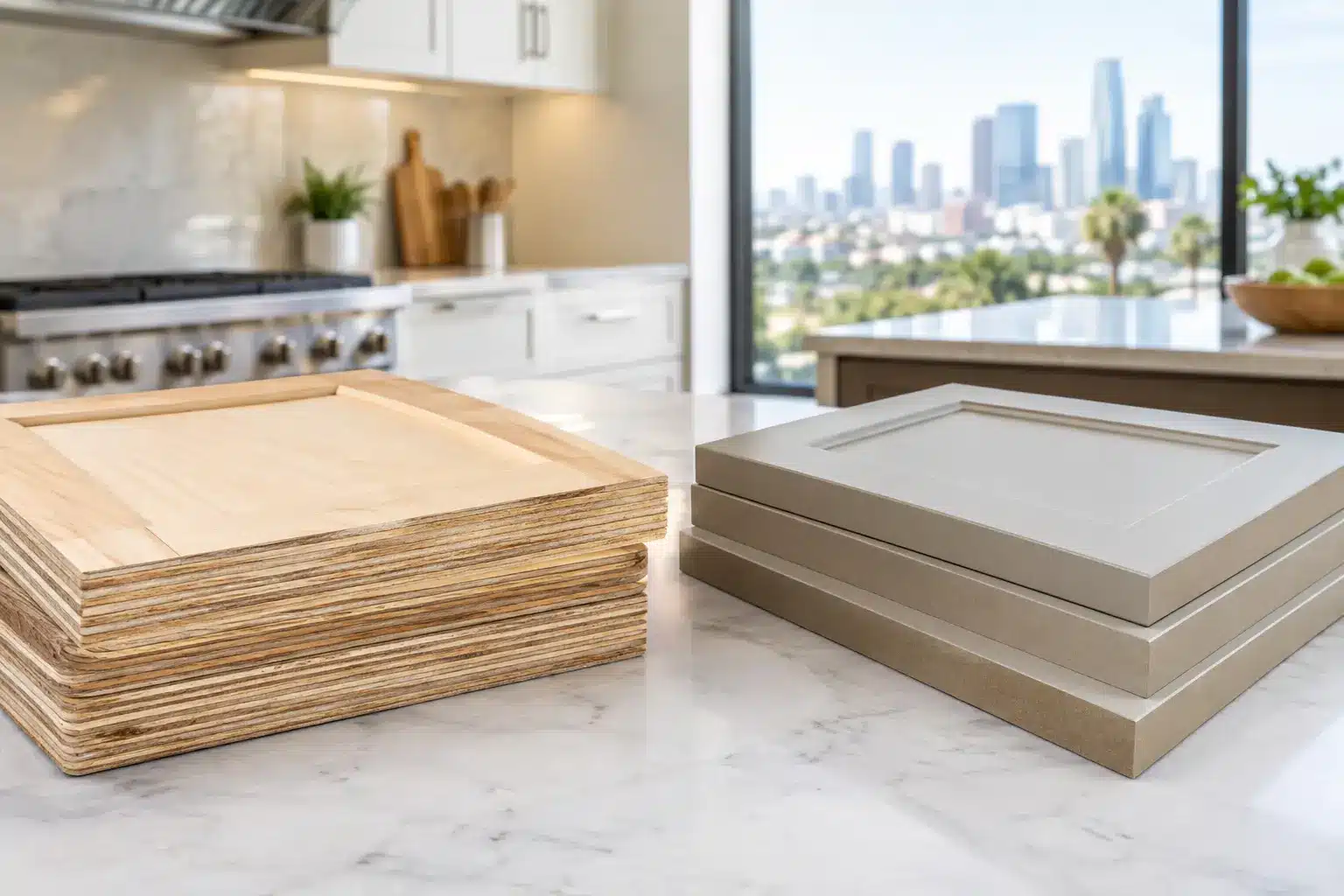
Plywood is made from thin wood veneers laminated in alternating grain directions. This layered construction gives it strength, screw-holding ability, and greater stability under everyday cabinet loads. Cabinet-grade plywood is commonly used for cabinet boxes, shelves, and sometimes doors.
MDF, short for medium-density fiberboard, is made from refined wood fibers combined with resin and compressed into dense, smooth panels. It has no wood grain, knots, or voids. That uniform surface makes it especially effective for painted cabinet doors, routed profiles, and detailed millwork.
Neither material is automatically “high end” or “low end.” Quality comes from the specific panel, its thickness, edge treatment, joinery, hardware, finishing process, and installation. A low-grade plywood box with thin edges and weak fasteners will not outperform a carefully fabricated MDF component in the right location.
Where Plywood Performs Best in a Kitchen
Plywood is generally the stronger choice for cabinet boxes, especially lower cabinets, sink bases, tall pantry units, and heavily loaded shelves. Its cross-laminated structure handles screws and fasteners well, which matters for hinges, drawer-slide mounts, and the repeated opening and closing that kitchens endure.
It is also more forgiving around moisture than standard MDF. Los Angeles has a relatively dry climate, but kitchens are not dry environments. A leaking supply line under a sink, a dishwasher failure, wet mop water, or persistent steam can damage cabinetry regardless of the weather outside. Plywood is not waterproof, but it is less likely than standard MDF to swell immediately when exposed to a small amount of moisture.
This makes plywood a practical choice for homes where durability is the first concern, including active family kitchens, rental properties, and homes near the coast where damp air and salt exposure can add pressure to finishes and interior materials. For sink cabinets, the protection details matter as much as the panel material: sealed cut edges, properly installed plumbing, protective liners, and prompt repair of leaks all extend cabinet life.
Plywood also has advantages when the cabinet interior will remain visible. A clear-coated or wood-veneer plywood interior can provide a refined, furniture-like appearance. For contemporary kitchens with natural oak, walnut, or white oak cabinetry, plywood-based construction can support the visual language of the design.
Not All Plywood Is Equal
The word “plywood” can create a false sense of security. Cabinet-grade plywood is different from inexpensive construction panels. Better panels have more consistent inner plies, fewer voids, stronger veneer faces, and cleaner edges. Thin panels with internal gaps can weaken shelf spans, make edge finishing difficult, and reduce holding power where hardware is installed.
For a kitchen designed to last, ask what type and thickness of plywood will be used for the boxes and shelves. In many custom applications, 3/4-inch material is a dependable standard for cabinet sides and fixed shelves. The fabricator should also explain how exposed edges will be finished and how boxes will be joined.
Where MDF Makes Sense
MDF is often the better material for painted cabinet doors and drawer fronts. Because its surface is smooth and free of grain, it accepts paint evenly. The result can be a clean, polished finish without the subtle texture or grain telegraphing that can occur on painted wood products.
It is also ideal for shaker doors with crisp profiles, slab doors with a very flat painted face, and decorative routed details. If your design calls for a tailored white, soft gray, deep navy, or custom lacquer color, MDF can produce a more consistent appearance than many natural wood options.
Another benefit is stability. Solid wood expands and contracts across its grain with changes in humidity. MDF does not behave in the same way, so properly finished MDF doors can remain very flat in climate-controlled interiors. That is useful in sleek, modern kitchens where uneven reveals between doors and drawers are immediately noticeable.
MDF is usually less expensive than premium cabinet-grade plywood, which can help direct more of the project budget toward better drawer hardware, a higher-quality finish, integrated lighting, stone fabrication, or custom storage features. Material savings should never come at the expense of construction quality, but thoughtful use of MDF can be a smart budget decision.
MDF’s Main Limitation: Water Exposure
Standard MDF absorbs water readily through unsealed edges, drilled holes, and damaged paint. Once it swells, it typically cannot be returned to its original shape. That is why MDF is generally not our first choice for cabinet boxes beneath sinks or other locations with a meaningful risk of plumbing leaks.
Moisture-resistant MDF is available and can offer better performance than standard MDF, but it is still not waterproof. It needs complete sealing and careful fabrication. For doors and decorative end panels away from direct water exposure, this is less concerning. For the cabinet structure itself, especially in a high-use kitchen, plywood offers more protection.
The Best Material Depends on the Cabinet Component
The strongest solution is often a hybrid cabinet specification. Plywood boxes provide a durable foundation for the kitchen, while MDF doors and painted panels deliver a clean, premium finish. This combination is common in custom kitchens because it places each material where it performs best.
A painted shaker kitchen, for example, may use 3/4-inch plywood cabinet boxes, plywood shelves, and MDF shaker doors with a durable sprayed finish. A natural wood kitchen may use veneered plywood boxes and wood veneer or solid wood doors, depending on the design. A budget-conscious remodel may use engineered cabinet components selectively, provided the sink base, shelves, hardware, and installation details are not compromised.
The key is avoiding a one-material rule. Choosing MDF for every component simply because it lowers the quote can lead to problems around sinks and heavy shelves. Choosing plywood for every painted face may increase cost without improving the final appearance. A clear cabinet plan should identify the material used in every major component rather than relying on broad labels like “all wood” or “premium construction.”
Construction Details Matter More Than Marketing Terms
When comparing cabinet proposals, look beyond the door sample. Ask about box material, panel thickness, back-panel construction, shelf thickness, drawer-box material, hinges, drawer slides, and edge banding. These are the elements you will rely on long after the paint color has become familiar.
Pay close attention to the sink cabinet. Confirm whether its bottom is protected, whether interior edges are sealed, and whether plumbing penetrations will be finished cleanly. Also ask how cabinet boxes will be leveled and secured to the wall. Los Angeles homes can have older framing, uneven floors, and walls that are far from perfectly straight. Precise installation, shimming, scribing, and alignment are essential to keeping door gaps even and countertops properly supported.
For condo kitchens and compact urban layouts, cabinet performance is also tied to storage planning. Deep drawers, pull-out trash systems, appliance garages, pantry rollouts, and properly supported floating shelves can have more day-to-day value than upgrading a material in a location where it provides little practical benefit.
How to Choose for Your Los Angeles Kitchen Remodel
Choose plywood-forward construction if your priority is durable cabinet boxes, strong shelves, reliable hardware mounting, and greater tolerance for the occasional kitchen leak. It is particularly appropriate for sink bases, large pantries, and kitchens that will see heavy daily use.
Choose MDF for painted doors, drawer fronts, and decorative panels when you want a smooth, consistent finish and crisp routed detail. It is a strong design choice when it is properly sealed and kept out of high-risk water-exposure areas.
Before approving cabinetry, request samples that show the actual finish and edge treatment, not just a color chip. Review the cabinet drawings in relation to appliances, plumbing, backsplash thickness, countertop overhangs, and clearances. A cabinet decision affects every trade in the room, which is why it should be coordinated before construction begins rather than corrected after installation.
At Precise Building and Restoration, we help homeowners evaluate cabinet materials in the context of the full kitchen – design, layout, plumbing, finishes, budget, and long-term use. A well-built kitchen does not need the most expensive material everywhere. It needs the right material in the right place, installed with care and planned around how your household actually lives.
For a kitchen that looks refined and performs reliably for years, start with a clear cabinet specification instead of a label on a showroom sample. Call Precise Building and Restoration at 310-606-2222 to discuss your Los Angeles kitchen remodel.