
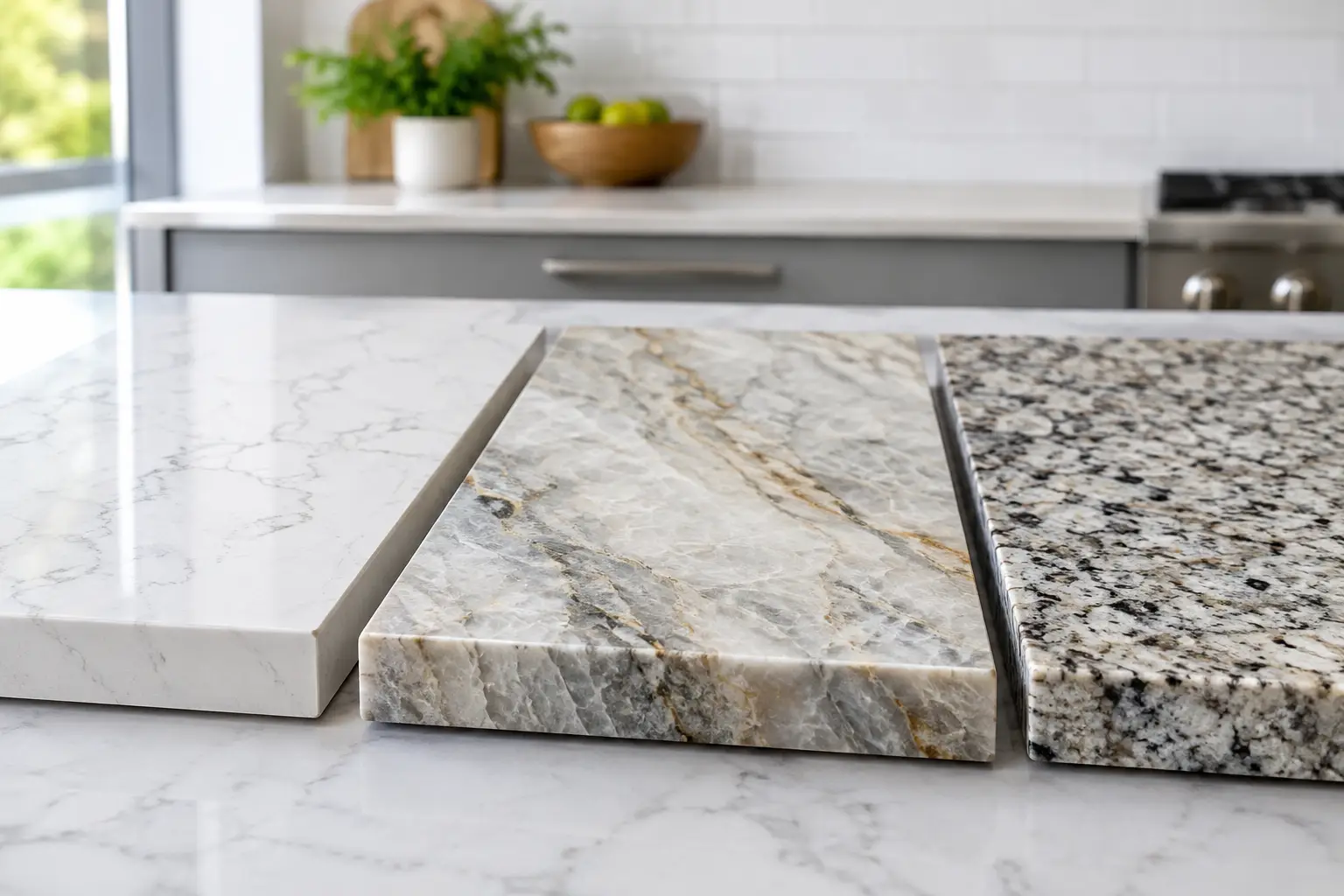
A countertop can make a kitchen look finished or make every other design decision feel slightly off. Quartz vs. quartzite vs. granite countertops: which one should you choose? The right answer depends less on what is trending and more on how your household cooks, cleans, entertains, and uses the space every day.
For a Los Angeles kitchen remodel, this choice also affects the project beyond appearance. Each material has different fabrication requirements, slab variation, seam considerations, maintenance needs, and budget implications. A polished kitchen begins with selecting a surface that fits both the design vision and the way the home actually functions.
Quartz vs. Quartzite vs. Granite Countertops: The Core Difference
Quartz countertops are engineered slabs, typically made from crushed natural quartz combined with resins and pigments. This manufacturing process creates a consistent, nonporous surface with a wide range of colors and patterns, including options that resemble marble or concrete.
Quartzite and granite are natural stones cut from the earth. Quartzite begins as sandstone and transforms under intense heat and pressure into a dense stone. Granite is an igneous rock formed as molten material cools beneath the earth’s surface. Both offer genuine mineral variation that cannot be perfectly repeated from one slab to the next.
That distinction shapes nearly every practical decision. Quartz offers predictability and low maintenance. Quartzite offers dramatic natural movement and exceptional hardness. Granite delivers a broad selection of natural looks, generally strong durability, and often more flexibility across price points.
Choose Quartz for Consistency and Easy Daily Care
Quartz is often the most practical choice for busy kitchens, especially for homeowners who want a refined look without adding regular sealing to their maintenance schedule. Because it is nonporous, quartz resists common household stains from coffee, wine, cooking oils, and sauces. Routine care is straightforward: use a soft cloth, mild soap, and water.
Its visual consistency is a major advantage in large kitchens. If a design calls for a clean white surface, a soft veining pattern, or a uniform charcoal tone across a long island and perimeter counters, engineered quartz makes that easier to achieve. It can also be a sensible option for a contemporary kitchen where the cabinetry, backsplash, and lighting already have strong visual detail.
The trade-off is heat resistance. Quartz is durable, but the resins in engineered slabs can be damaged by extreme, direct heat. A hot pan should never go straight from the range or oven onto a quartz countertop. Trivets are a simple habit, but they are necessary.
Quartz is also not automatically the best option for every sun-filled kitchen. Long-term, intense UV exposure can affect some products, particularly near large windows or in outdoor installations. In a bright Los Angeles home, material selection should account for where sunlight falls throughout the day, not just how the sample looks in a showroom.
Choose Quartzite for Natural Drama and High Heat Resistance
Quartzite is a strong fit when the homeowner wants the organic movement of natural stone but expects serious performance. Many quartzite slabs feature sweeping veining, crystalline texture, and subtle color shifts that give an island a true focal-point presence. No printed pattern fully duplicates that depth.
It is also extremely hard and highly heat resistant, which appeals to households that cook frequently. While no countertop is indestructible, quartzite generally handles daily wear very well when it is properly selected, fabricated, installed, and maintained.
The key phrase is properly selected. The stone industry uses names that can be confusing, and materials labeled as quartzite do not always perform alike. Some slabs sold under that name may be softer or more porous than expected. Before committing, a qualified fabricator should identify the specific slab, evaluate its characteristics, and explain the recommended sealing and care routine.
Most quartzite needs periodic sealing because it is a natural stone. Sealing does not make the surface maintenance-free, but it helps reduce the risk of stains penetrating the stone. Homeowners should still wipe spills promptly, particularly acidic liquids such as lemon juice, vinegar, or wine. Depending on the specific material, some quartzites can also be more sensitive to etching than buyers anticipate.
Quartzite often costs more than standard granite or entry-level quartz, particularly for premium slabs with dramatic movement. Fabrication can also require additional care due to the material’s density and hardness. If the design is centered on a statement island, that investment can be worthwhile. If the goal is a clean, durable work surface throughout a hardworking family kitchen, quartz may provide better value.
Choose Granite for One-of-a-Kind Character and Proven Performance
Granite has remained a popular countertop material for good reason. It is natural, durable, heat resistant, and available in an enormous range of colors and patterns. Some slabs are quiet and understated; others have bold mineral movement, sparkling crystals, or deep, dramatic tones.
For homeowners who want natural stone but do not need the marble-like look that often drives quartzite selections, granite can be an excellent middle ground. It performs well in active kitchens and is generally less vulnerable to heat than quartz. It can also be suitable for outdoor kitchens when the specific slab and installation details are appropriate for the environment.
Like quartzite, granite is porous to varying degrees and should be sealed according to the stone’s needs. A properly sealed granite countertop is manageable for everyday living, but it still benefits from prompt cleanup and nonabrasive cleaning products. Harsh chemicals can dull the finish or weaken the sealant over time.
Granite’s main design consideration is variation. A small sample may not tell the full story of the slab. Veining, color concentration, and mineral deposits can shift substantially from one end to another. Viewing the actual slabs before fabrication is essential, especially when matching a waterfall island, full-height backsplash, or multiple countertop runs.
Compare the Materials Where It Matters Most
There is no universal winner because each surface makes a different promise. Quartz prioritizes ease and visual control. Quartzite prioritizes natural beauty and high-performance hardness. Granite prioritizes distinctive natural character with time-tested durability.
For stain resistance and low-maintenance living, quartz usually leads. For direct heat resistance, quartzite and granite have an advantage, though trivets remain good practice for every material. For a consistent pattern across a large kitchen, quartz is the clearest choice. For a singular, natural slab that becomes part of the architecture, quartzite or granite is often more compelling.
Budget should be evaluated as a full installed scope, not only as a square-foot number. The final cost may include slab selection, templating, fabrication, edge profiles, sink and cooktop cutouts, transport, installation, demolition of existing countertops, backsplash work, plumbing reconnection, and any structural adjustments for a heavy island. A more affordable slab can become costly if the layout has complex seams or requires extensive material waste. Conversely, a premium slab may make sense when the design uses it strategically on one visible feature.
Plan the Countertop With the Entire Kitchen, Not in Isolation
The most successful countertop selection is made after the cabinet layout, appliance locations, sink style, backsplash plan, and lighting approach are understood. For example, a heavily veined quartzite may look exceptional with simple cabinetry but compete with a busy tile backsplash. A quiet quartz can support a dramatic walnut veneer or richly colored painted cabinets without overwhelming the room.
Seam placement deserves early attention. Large islands, L-shaped kitchens, and slabs with directional veining may require seams, and skilled planning makes them less noticeable. The fabricator should also discuss edge profiles, overhang support, mitered edges, and whether the stone will continue vertically as a backsplash or waterfall panel.
In a full renovation, countertop decisions should be coordinated with the schedule. Cabinets must be installed and leveled before final templating. Once the template is complete, fabrication and installation follow, then plumbing and finish work can be completed. Managing these steps in the right sequence protects both the material and the project timeline.
A beautiful slab is only part of the result. Precise Building and Restoration helps homeowners coordinate design decisions, construction details, skilled installation, and finish work so the completed kitchen feels intentional from every angle.
Before choosing, view full slabs in person, bring cabinet and backsplash samples, and ask direct questions about sealing, heat exposure, seams, and fabrication. The best countertop is the one you will enjoy using as much as looking at. For clear guidance on your Los Angeles kitchen remodel, call Precise Building and Restoration at 310-606-2222.