A beautiful remodel can still feel disappointing if one room runs hot every afternoon, outside noise travels through the walls, or the new HVAC system works harder than it should. When comparing fiberglass vs. mineral wool vs. spray foam insulation, the right choice is rarely about picking the material with the highest advertised rating. It is about matching the insulation to the assembly, the home’s age, the local climate, and the scope of the renovation.
For Los Angeles homeowners, insulation decisions often arise during a full-home remodel, ADU conversion, garage conversion, room addition, or roof replacement. Once walls and ceilings are open, there is an opportunity to improve comfort, energy performance, and sound control that may not be available again for decades.
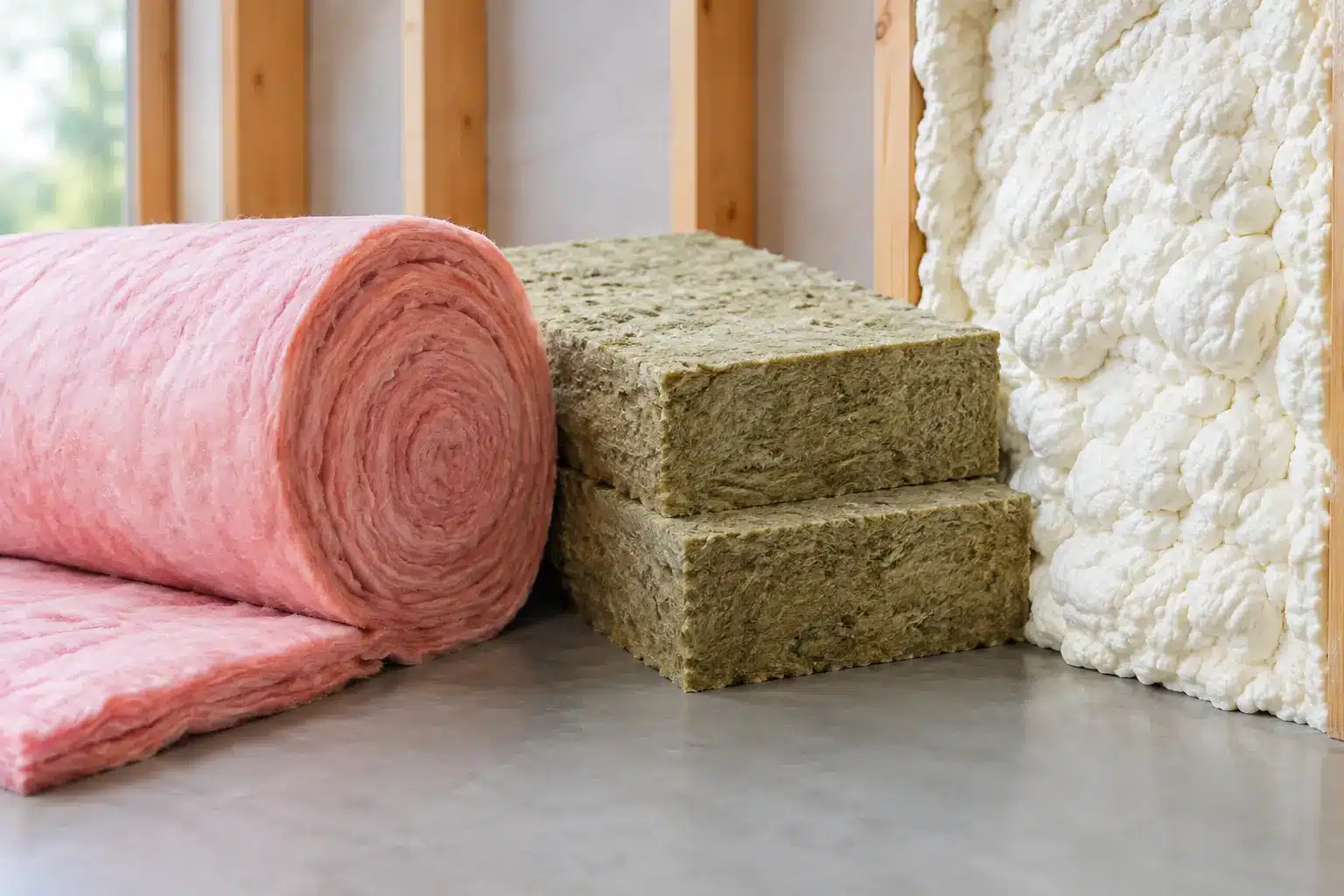
Fiberglass vs. Mineral Wool vs. Spray Foam Insulation
Fiberglass, mineral wool, and spray foam can all perform well when they are specified and installed correctly. They do different jobs, carry different costs, and require different levels of attention to air sealing and moisture management.
Fiberglass is generally the most economical and widely used option. Mineral wool offers excellent fire and acoustic performance while handling moisture differently than fiberglass. Spray foam creates insulation and air sealing in one application, but it is more expensive and demands careful design, preparation, and installation.
The best material may vary within the same project. A remodeled exterior wall, a garage ceiling below a bedroom, a vented attic, and a tight roof assembly do not necessarily need the same insulation strategy.
Fiberglass: Practical, Familiar, and Budget-Conscious
Fiberglass insulation is available as batts, rolls, and blown-in material. It is popular because it is cost-effective, readily available, and familiar to most crews. It can provide solid thermal performance in standard wall cavities and attic floors when installed without gaps, compression, or voids.
That installation detail matters. A batt that is cut poorly around wiring, plumbing, or framing does not perform like the label suggests. Fiberglass also does not stop air movement on its own, so the wall or ceiling assembly still needs thoughtful air sealing at penetrations, transitions, top plates, and other leakage points.
For many renovation budgets, fiberglass is a sensible choice for interior walls, garage ceilings, and accessible attic spaces. It can also support sound reduction when used in partition walls, especially when paired with proper drywall detailing. However, if sound privacy is a primary concern between a home office, media room, bedroom, or ADU unit, mineral wool may offer a stronger result.
Mineral Wool: Strong for Sound, Fire, and Dense Assemblies
Mineral wool, sometimes called rock wool or stone wool, is made from mineral-based fibers formed into dense batts or boards. Its density is one reason it performs well acoustically. In practical terms, it can help reduce voices, television noise, and everyday sound transfer through walls and floor-ceiling assemblies.
It is also noncombustible, which can make it an appealing component in projects where fire-resilient construction is a priority. This does not mean insulation alone makes an assembly fireproof. Fire performance depends on the full system, including framing, sheathing, drywall, penetrations, and code-required details. Still, mineral wool brings a meaningful advantage in this category.
Another benefit is moisture behavior. Mineral wool is water-resistant and can dry when exposed to incidental moisture, unlike materials that can hold water against framing. It is not a substitute for correcting a roof leak, plumbing leak, or drainage issue, but it is a durable choice in wall and roof assemblies where moisture control is carefully planned.
The trade-off is cost. Mineral wool commonly costs more than fiberglass, and its denser batts may take more time to cut and fit. For homeowners focused on quieter bedrooms, shared walls, garage conversions, or premium remodels near busy streets, the added investment can be justified.
Spray Foam: Air Sealing With Important Trade-Offs
Spray foam insulation is applied as a liquid that expands and hardens in place. Open-cell foam is lighter and more vapor-permeable, while closed-cell foam is denser, provides a higher R-value per inch, and can serve as an air and moisture control layer in the right assembly.
Its biggest advantage is air sealing. Gaps around irregular framing, roof penetrations, and difficult-to-reach cavities can be sealed more effectively than with batt insulation alone. This can be particularly useful in older Los Angeles homes, where uneven framing and numerous penetrations are common.
Spray foam is not automatically the premium answer, however. It is usually the most expensive of the three options, and a poor installation can create real problems. The substrate must be dry, the foam must be applied at the proper thickness, and the home must be ventilated appropriately during installation and curing. Foam also changes how a roof or wall assembly dries, so the design needs to account for local conditions and applicable building code requirements.
Where spray foam is used in attic or roof assemblies, HVAC planning becomes especially important. Creating a conditioned attic can improve performance, but it may change ventilation details, equipment loads, and access needs. It should be treated as a building-system decision, not a stand-alone product upgrade.
How to Choose Insulation for Your Remodel
Start with the location of the insulation, not the product name. Exterior walls need a strategy for thermal performance, air control, and moisture management. Interior walls may prioritize sound control. A ceiling below an unconditioned garage needs thermal separation, while an ADU or garage conversion may need a combination of energy, sound, and fire-rated assembly requirements.
Next, consider what will be difficult to improve later. If exterior walls are already open during a major renovation, it may make sense to add air sealing and higher-performing insulation while access is available. If the concern is only noise between two rooms, a targeted mineral wool installation may provide more value than applying spray foam throughout the project.
Homeowners should also consider the condition of the existing building. Insulation cannot solve water intrusion, failed flashing, damaged roof sheathing, unsealed ducts, or undersized HVAC equipment. Those issues should be identified before finishes are closed. Otherwise, a project can end up with better insulation around the same underlying problem.
Cost Should Be Measured Over the Full Scope
Material price is only one part of the equation. Labor, demolition, wall access, air sealing, drywall repair, permit requirements, and HVAC adjustments can have a greater impact on the final budget than the insulation itself.
Fiberglass often provides the lowest upfront cost. Mineral wool is typically a mid-range to premium option, particularly when acoustic performance matters. Spray foam has the highest initial investment but can be valuable in specific locations where air leakage or limited cavity depth is the central challenge.
A good contractor should explain where additional cost produces a tangible benefit and where it does not. Spending more on foam in an easy-to-insulate wall may offer limited return. Spending more on mineral wool in a bedroom wall beside a noisy living area may noticeably improve daily comfort.
Installation Quality Determines the Result
No insulation material can compensate for careless workmanship. Batts need full, consistent contact with the cavity. Blown insulation needs proper depth and coverage. Mineral wool must be cut cleanly around obstructions. Spray foam must be installed by qualified professionals who understand thickness, curing, ventilation, and the surrounding assembly.
Before drywall goes up, the project team should inspect insulation coverage, air sealing, plumbing penetrations, electrical boxes, and any required fire blocking. This is a small checkpoint with a major payoff because correcting missed areas after finishes are complete is disruptive and expensive.
For projects in Los Angeles, permitting and energy-code compliance can also shape the final specification. An experienced design-build contractor can coordinate insulation choices with plans, mechanical work, inspections, and finish details rather than treating insulation as an isolated line item.
The right insulation should make the finished home feel quieter, more even in temperature, and more comfortable without adding avoidable complexity. A clear plan before walls are closed protects both the project budget and the quality of the result.
If you are planning a remodel, addition, ADU, or garage conversion, Precise Building and Restoration can help evaluate the insulation strategy as part of the full construction plan. Call us now at 310-606-2222.