A backyard ADU can look straightforward on a site plan, then become more complicated when utilities enter the conversation. So, how much do ADU utility connections cost? For many Los Angeles properties, homeowners should budget roughly $10,000 to $40,000 for utility-related work. Projects with long runs, difficult access, aging infrastructure, or a major electrical or sewer upgrade can exceed that range.
The useful number is not a single flat price. It is a project-specific utility plan based on where your existing services enter the property, the ADU’s size and equipment, local utility requirements, and what must be opened, replaced, and restored after the work is complete.
What Is Included in ADU Utility Connection Costs?
Utility costs cover more than connecting a few pipes and wires to a new unit. A complete scope may include electrical capacity evaluation, new panels or subpanels, trenching, water lines, sewer lines, gas piping when applicable, inspections, utility-company coordination, and the repair of concrete, paving, landscaping, or finishes affected by excavation.
For an attached ADU, garage conversion, or JrADU, some services may be able to extend from the main residence with shorter runs and less site disturbance. A detached backyard ADU often needs deeper trenching and more extensive underground work. On a hillside, a narrow lot, or a property with mature landscaping and hardscape, access alone can materially change the budget.
It also helps to separate construction costs from agency charges. Connection fees, meter fees, plan review, permits, school fees, and other municipal requirements are not always included in a contractor’s utility installation price. A detailed project budget should identify each category clearly rather than grouping everything under a broad allowance.
How Much Do ADU Utility Connections Cost by System?
Every site is different, but preliminary ranges can help homeowners understand where the budget goes before final plans and field verification are complete.
Electrical service and power
Electrical work is frequently the largest utility variable. A modest ADU may be served by an appropriately sized subpanel from the main house, provided the existing service has enough capacity. In that scenario, electrical trenching, conduit, wiring, panel work, and connection can commonly fall in the $5,000 to $15,000 range.
If the existing home has an older 100-amp service, a crowded panel, or planned high-demand equipment such as electric HVAC, induction cooking, EV charging, or all-electric water heating, an upgrade may be necessary. A service upgrade, new meter equipment, utility coordination, and related site work can bring the electrical portion to $15,000 to $30,000 or more.
The trade-off is worth evaluating early. An all-electric ADU can avoid new gas piping, but it may require more electrical capacity. The best answer depends on the home’s current infrastructure and the design of the new unit, not a preference for one system over another.
Water connection
A water connection may be relatively simple when a properly sized existing service can accommodate the ADU. Extending a new cold-water line from the house can often cost approximately $3,000 to $10,000, depending on distance, trench conditions, shutoff requirements, and restoration.
A larger ADU or a property with an undersized service may require a new or upgraded water service. Meter changes and water-agency requirements can add time and cost. Homes in older Los Angeles neighborhoods sometimes have aging galvanized piping or prior additions that were never designed for the demands of a separate dwelling. In those cases, addressing the main service as part of the ADU project can prevent future pressure and maintenance problems.
Sewer connection
Sewer work deserves careful attention because the condition and location of the existing lateral matter as much as the distance to the ADU. A straightforward branch connection to a sound private sewer lateral may cost about $5,000 to $15,000. Costs rise when the line is deep, the slope is difficult, the existing lateral needs replacement, or excavation must cross concrete, a driveway, or a landscaped yard.
Where gravity flow is not practical, a sewage ejector system may be needed. That introduces equipment, electrical requirements, maintenance considerations, and additional installation cost. It is not automatically a reason to avoid an ADU, but it needs to be designed correctly from the start.
A sewer camera inspection before final pricing is often a smart investment. It can reveal root intrusion, offsets, deteriorated pipe, or an undersized line before the project is under construction. Discovering those issues after a slab is opened is far more disruptive.
Gas connection
Natural gas is not required for every ADU. If the unit will use a gas range, gas water heater, or gas-fired heating equipment, a new line or extension may be necessary. Typical gas piping work can range from $2,000 to $8,000, but the required size, length, routing, and utility requirements can move that number.
Many homeowners choose electric heat-pump HVAC and heat-pump water heating to simplify the gas scope. That choice can reduce one type of utility work while increasing electrical planning. A capable design-build team evaluates the whole system so a decision in one trade does not create an unexpected cost in another.
The Site Conditions That Change the Price Most
The distance from the main house to the ADU is a major driver, but it is not the only one. A 40-foot trench through open soil is very different from a 40-foot trench that crosses a decorative paver courtyard, retaining wall, pool deck, or mature garden.
Older homes can also require more investigation. Original electrical panels, clay sewer pipes, undersized water lines, and undocumented prior work are common factors in renovation-era properties. In premium neighborhoods where finished outdoor spaces carry real value, restoration should be treated as part of the utility scope, not an afterthought.
Access affects labor and equipment choices as well. If machinery cannot reach the backyard, excavation may need to be performed with smaller equipment or by hand. Hillside conditions, protected trees, high water tables, and tight side-yard clearances may add engineering or specialized construction requirements.
Utility Fees vs. Construction Costs
Homeowners often hear a utility number and assume it includes everything. It may not. Construction costs pay for physical installation: trenching, piping, conduit, wiring, panels, connections, testing, and restoration. Fees are charged by cities, departments, or utility providers for permits, reviews, meters, inspections, or service changes.
Los Angeles ADU rules and utility policies can change, and requirements may differ by property type and service provider. A detached unit may have different metering options and requirements than an attached ADU or JrADU. The key is to obtain written clarification for the specific property rather than relying on a neighbor’s project from several years ago.
How to Get a Reliable Utility Budget Before Building
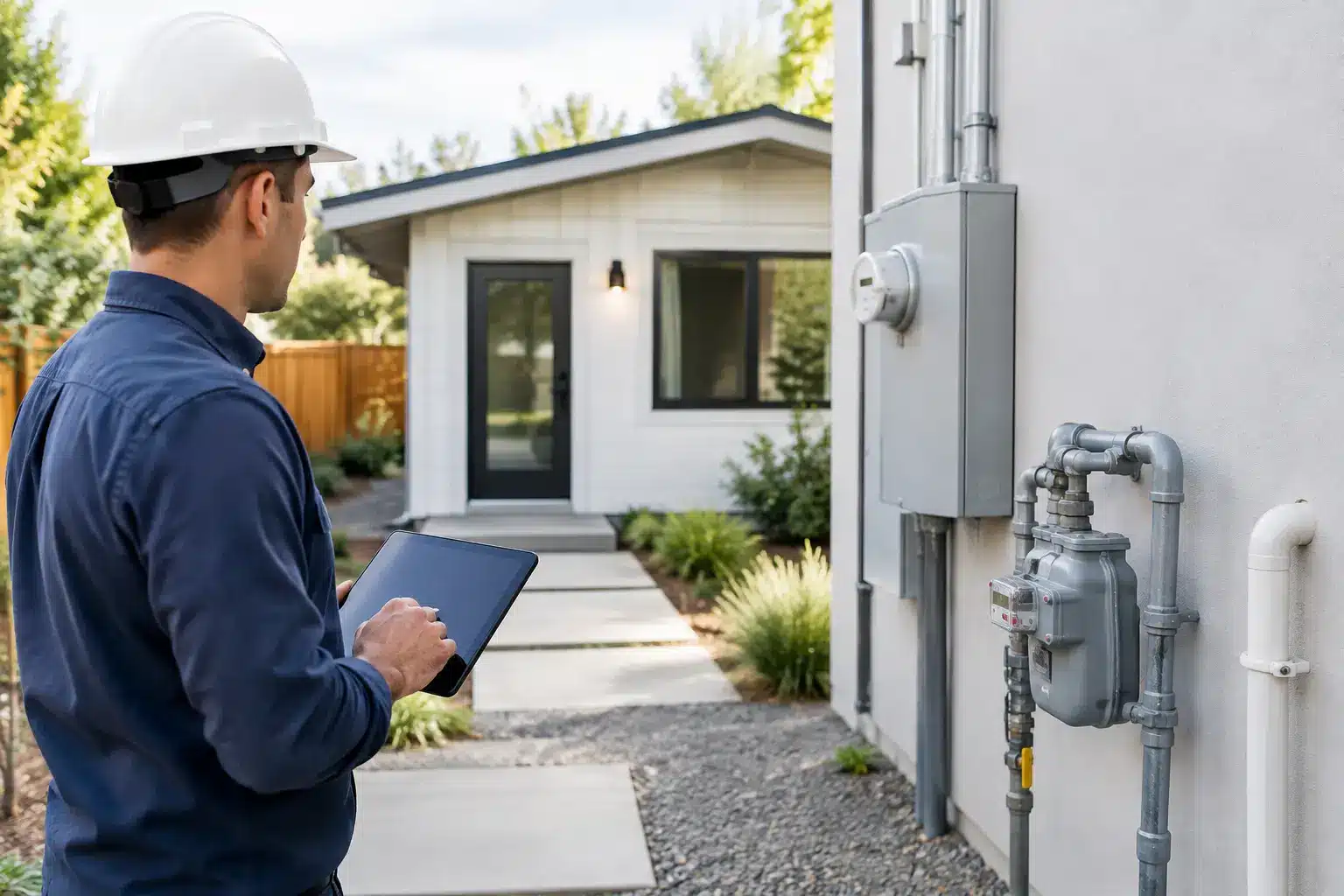
The most reliable budget comes after a site assessment, not from a generic price per square foot. Start by locating the main electrical panel, water meter, gas meter, sewer cleanout, and visible utility routes. Existing plans are helpful, but field conditions should be verified.
Next, confirm the ADU’s major loads and fixtures. The electrical design changes when the project includes a full kitchen, laundry, electric cooking, multiple mini-splits, or EV charging. Plumbing design changes with the number of bathrooms, fixture locations, and whether the unit sits above or below the elevation of the existing sewer line.
Finally, request a scope that separates allowances from confirmed work. A transparent proposal should explain what is included for utility trenching, service upgrades, permit coordination, utility-provider requirements, and restoration. That clarity makes it easier to compare proposals without choosing a lower initial number that excludes essential work.
At Precise Building and Restoration, we coordinate ADU design, permitting, utility planning, construction, and finish work as one accountable process. If you are considering an ADU in Los Angeles and want a site-specific utility assessment before committing to a build, call 310-606-2222. A clear utility plan early in the process protects both your budget and the finished property.