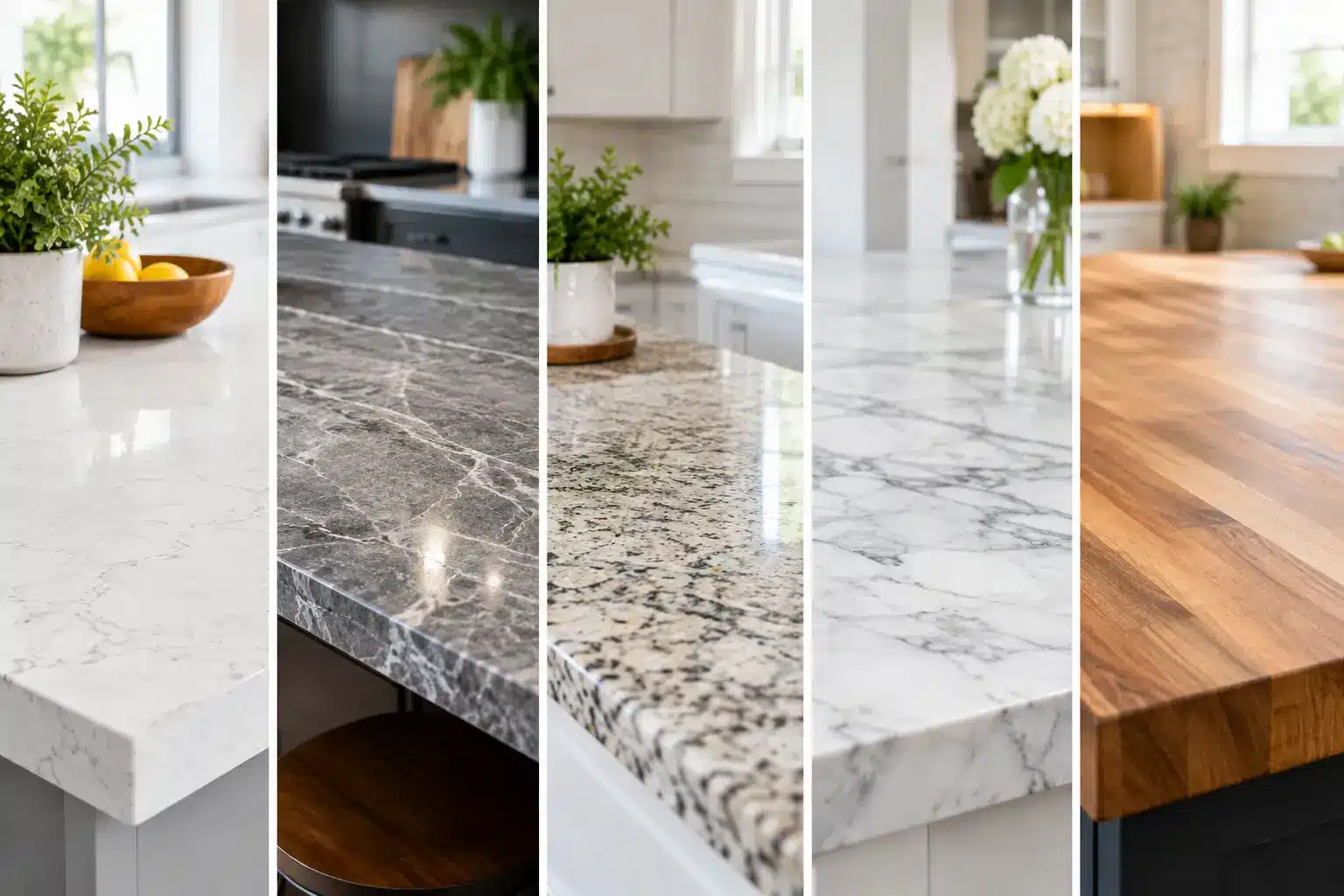
A countertop decision becomes very real when the slab is in front of you: the veining looks different under your kitchen lighting, the edge profile changes the feel of the room, and a beautiful sample suddenly has to work beside a busy range, a sink, and everyday life. When choosing quartz, quartzite, granite, marble, porcelain, or butcher block countertops, the right answer is rarely about what is most expensive or most popular. It is about how your household uses the kitchen, how much maintenance feels reasonable, and how the material supports the design you want for years to come.
For Los Angeles homeowners planning a kitchen remodel, countertop selection should happen early enough to influence cabinet layout, backsplash details, sink choices, and appliance clearances. A qualified design-build team can help you see those connections before materials are ordered and fabrication begins.
Quartz, Quartzite, Granite, Marble, Porcelain, or Butcher Block Countertops?
Each of these surfaces can create an exceptional kitchen. Their differences are most visible not in a showroom, but after six months of meal prep, entertaining, cleaning, and sunlight through the windows. The key is matching the material to the demands of the room rather than asking one surface to do everything perfectly.
Quartz: Consistent, Low-Maintenance, and Design-Flexible
Quartz is an engineered surface made primarily from natural quartz minerals combined with resins and pigments. Its greatest advantage is predictability. Homeowners can choose from crisp whites, soft concrete looks, dramatic veining, and warmer stone-inspired patterns while maintaining a consistent appearance across the kitchen.
Because quartz is nonporous, it does not require routine sealing and resists staining better than many natural stones. It is an especially practical choice for active family kitchens, condos, and homeowners who want a polished look without adding a maintenance task to their calendar. It also works well for a large island where a uniform pattern is part of the design intent.
The trade-off is heat sensitivity. A hot pan should not be placed directly on quartz, and intense heat near cooktops needs careful planning. Some quartz patterns can also look more manufactured than a true natural slab, particularly when compared with high-movement quartzite or marble. Viewing full slabs, not just small samples, is essential.
Quartzite: Natural Drama With Serious Durability
Quartzite is a natural stone formed under intense heat and pressure. It is often selected by homeowners who love the movement and depth of marble but want a harder surface for a hardworking kitchen. Many quartzites feature flowing veins, crystalline variation, and colors that give an island a true focal-point presence.
It is generally harder than marble and can perform well in a busy kitchen when properly sealed and cared for. However, quartzite is not maintenance-free. It should be sealed as recommended by the fabricator, and spills should be cleaned promptly. Fabrication can also be more demanding because of its density and hardness, which may affect the project budget.
There is another important detail: stone names can be confusing. Some materials marketed as quartzite may have different mineral compositions and performance characteristics. Confirm the specific slab, ask the fabricator about sealing and care requirements, and do not choose based on a label alone.
Granite: One-of-a-Kind Natural Stone
Granite remains a strong choice for homeowners who want natural stone with durability and visual individuality. No two slabs are identical. That can be a major advantage in a custom kitchen where the countertop is meant to feel collected, organic, and unmistakably yours.
Granite holds up well to heat and everyday use, and many varieties are less prone to etching than marble. Modern granite is also available in far more than the heavily speckled patterns many people remember from older kitchens. Leathered, honed, and polished finishes can give granite a contemporary, understated character.
Like most natural stone, granite benefits from sealing. Its movement can be either an asset or a challenge depending on the rest of the design. A highly active slab may compete with a patterned backsplash or heavily grained cabinetry. In a calm palette with simple cabinet fronts, it can be exactly the element that gives the room depth.
Marble: Timeless Beauty That Develops Character
Marble is difficult to duplicate convincingly because it has natural softness, depth, and veining that feel refined in both classic and contemporary kitchens. It is a compelling choice for homeowners who value patina and understand that a kitchen surface can become more beautiful as it shows signs of use.
That perspective matters. Marble can etch when exposed to acidic foods and drinks, and it can stain if spills are left untreated. Etching is not necessarily damage in a structural sense, but it can change the finish and create dull marks. For some households, that is unacceptable. For others, it is part of the material’s appeal.
Marble often works best when expectations are clear from the beginning. It can be a beautiful island surface in a lower-intensity kitchen, a statement baking area, or a material used in a kitchen where owners are comfortable with attentive care. If you want marble’s visual language with fewer concerns, quartzite or a high-quality marble-look porcelain may be worth considering.
Porcelain: Thin, Versatile, and Heat-Resistant
Porcelain slab countertops have earned attention for their clean appearance, resistance to heat, and wide range of designs. They can mimic natural stone, concrete, metal, or minimalist solid colors while offering a nonporous surface that does not need sealing. Their UV resistance can also make them useful for indoor-outdoor kitchen concepts common in Southern California homes.
Porcelain is highly durable, but it is not indestructible. The slab is thinner than many stone countertops, and its edges require experienced fabrication and installation. A hard impact on an exposed edge can cause chips. Details such as mitered edges, waterfall panels, and cutouts around sinks and cooktops should be planned carefully by professionals familiar with the material.
For homeowners pursuing a modern kitchen with large-format surfaces and restrained veining, porcelain can be an excellent fit. It is particularly appealing when you want continuity from countertop to backsplash without the maintenance demands of porous natural stone.
Butcher Block: Warmth You Can Actually Use
Butcher block introduces something stone cannot: genuine warmth. Wood counters soften kitchens with painted cabinetry, add contrast to sleek modern finishes, and make an island feel more inviting. They are also quieter and gentler on glassware than hard surfaces.
The practical side is more involved. Wood needs regular oiling or a durable protective finish, depending on how it will be used. It can scratch, dent, and show water damage if seams around sinks are not properly detailed. Direct food preparation is possible on an appropriately maintained butcher block surface, but many homeowners prefer it for a section of the island, a baking station, or a bar rather than the entire kitchen.
Butcher block is often at its best as a deliberate accent. Pairing a wood-topped island with quartz, granite, or porcelain perimeter counters can create visual balance while placing the more maintenance-sensitive material where it will be appreciated most.
Choose for the Kitchen You Will Actually Live In
Start with your daily habits. If the kitchen is heavily used by children, frequent cooks, or regular guests, a low-maintenance surface such as quartz or porcelain can reduce worry. If you prioritize natural variation and are willing to seal and care for the material, granite or quartzite may deliver the character you want. If nothing compares to the look of marble, select it with open eyes and a realistic understanding of patina.
Then consider the full design rather than the countertop in isolation. Cabinet color, backsplash scale, flooring, hardware, lighting temperature, and the island’s size all affect whether a slab feels calm or overwhelming. A small sample cannot show how a bold stone will read across a ten-foot island, which is why slab selection and layout planning matter.
Details also affect performance. The right edge profile can reduce chipping risk, a properly supported overhang can make seating safe, and a well-planned sink cutout can protect vulnerable areas. These are construction decisions, not just design decisions.
At Precise Building and Restoration, we help homeowners coordinate material selection with cabinet design, field measurements, fabrication, and installation so the finished kitchen looks intentional from every angle. If you are weighing surfaces for a kitchen remodel and want clear guidance before construction begins, call us at 310-606-2222. The best countertop is the one that fits your home beautifully and still feels right on an ordinary Tuesday night.