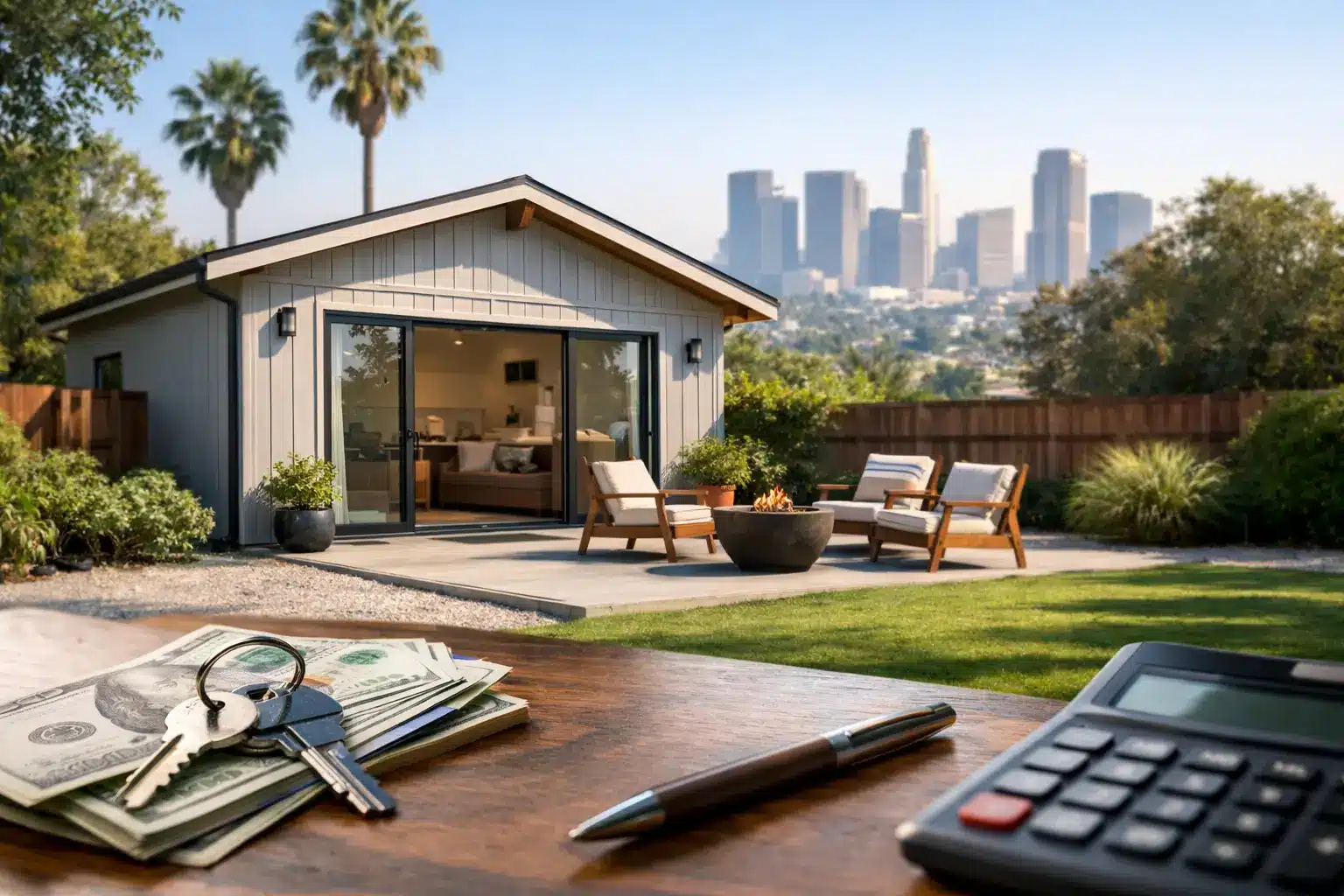
A well-planned ADU can turn unused backyard space, a detached garage, or part of an existing home into a meaningful income-producing asset. But how much rental income can a Los Angeles ADU generate? The honest answer is that it depends on the unit’s size, location, finishes, privacy, parking, and whether it is designed for the long-term tenants most owners want to attract.
For many Los Angeles homeowners, a professionally built ADU can rent for roughly $1,900 to $4,500 or more per month. A compact studio in a modest location will sit at the lower end of that range. A private, well-finished one- or two-bedroom unit in areas such as Santa Monica, Brentwood, Culver City, Westwood, or Studio City can command substantially more. The difference is rarely just square footage. It is the quality of the living experience.
What a Los Angeles ADU Can Rent For
Rental rates move with the market, so no contractor should promise a fixed return before reviewing the property and local comparable rentals. Still, these broad long-term rental ranges can help homeowners start a realistic conversation:
- A studio or junior ADU may rent for approximately $1,900 to $2,600 per month.
- A one-bedroom ADU, commonly between 450 and 700 square feet, may rent for about $2,300 to $3,400 per month.
- A two-bedroom detached ADU with strong finishes and privacy may bring in $3,200 to $4,500 per month or more.
- Larger, highly upgraded units in premium neighborhoods can exceed these figures when the layout, access, and property setting support the price.
A 650-square-foot one-bedroom unit rented at $2,650 per month would produce $31,800 in annual gross rent. That is a useful headline number, but it is not the same as net income. Vacancy, utilities, maintenance, insurance, property management, financing, and tax considerations all affect the money that remains in the owner’s pocket.
Why Similar ADUs Can Earn Very Different Rents
An ADU is not simply a smaller house. It needs to function like a complete home while respecting the main residence and the surrounding neighborhood. Tenants notice the details immediately: Can they enter without walking through the owner’s yard? Is there natural light? Is the kitchen practical? Can they do laundry? Do they have outdoor space, storage, and a comfortable place to park or unload groceries?
Privacy is often one of the strongest rent drivers. A detached backyard ADU with its own walkway, fenced patio, separate address, and clear separation from the primary home will generally appeal to more tenants than a unit with shared circulation and limited outdoor space. A garage conversion can perform very well too, particularly when the existing structure allows for a smart floor plan, proper insulation, good ceiling height, and an inviting entrance.
Location also matters, but not only because of a neighborhood name. Proximity to employment centers, transit, hospitals, universities, beaches, shopping, and major routes can broaden the tenant pool. A clean, secure, thoughtfully designed ADU in a convenient Los Angeles location may rent faster and experience less turnover than a larger unit with compromises that are hard to live with.
Design Decisions That Support Better Rental Income
Rental income starts with planning, not with listing photos. The best layouts make every square foot work. That may mean positioning the bedroom away from the main home, giving the kitchen enough counter space, creating room for a full-size refrigerator, or including built-in storage where a tenant actually needs it.
A polished ADU does not need extravagant finishes in every room. It does need durable, cohesive materials that look good after years of use. Quality flooring, properly selected countertops, reliable fixtures, efficient lighting, quiet HVAC, and sound insulation are practical investments. They improve the tenant experience while reducing frequent repair calls and premature replacement costs.
Windows deserve careful attention. More glass is not automatically better if it compromises privacy or creates heat gain. The right window placement can bring in daylight, frame a backyard view, and preserve separation between the ADU and main house. This is where design and construction coordination matters. A good plan should account for aesthetics, energy performance, structural requirements, and city approvals before crews begin work.
Gross Rent Is Only Part of the Return
When evaluating how much rental income a Los Angeles ADU can generate, homeowners should model the unit as a small rental business. Start with expected monthly rent, then subtract a realistic allowance for vacancy and operating costs.
For the $2,650-per-month example, a 5 percent vacancy reserve equals about $1,590 annually. The owner may also need to budget for utilities if they are included in rent, routine maintenance, insurance adjustments, landscaping, pest control, property management, and occasional turnover expenses. Net operating income may land closer to $22,000 to $25,000 annually before debt service and income taxes, depending on how the unit is managed.
The exact numbers vary. A homeowner who self-manages a unit and separately meters utilities may have lower ongoing expenses. An owner who includes utilities, hires a manager, or offers furnished housing may have different costs and potentially different rental potential. Speak with a qualified tax professional and financial advisor about depreciation, financing, property tax implications, and the income rules that apply to your situation.
Construction Cost and Payback Need a Clear Plan
An ADU should be evaluated as both a lifestyle improvement and a long-term property decision. Costs can vary widely based on site access, utility connections, slope, foundation needs, existing structure conditions, fire requirements, size, finish selections, and the complexity of permits.
A detached ADU often requires more extensive site work and utility planning than a conversion, but it can offer stronger privacy and design flexibility. A garage conversion may use an existing structure and reduce some construction scope, yet it can still require significant work to meet current building standards. Foundations, framing, insulation, plumbing, electrical upgrades, sewer connections, and code-compliant egress should never be treated as shortcuts.
The simplest payback calculation divides the total project investment by annual net income. For example, if a project costs $250,000 and produces $24,000 in annual net operating income before financing and taxes, the basic payback period is a little over 10 years. That calculation does not account for appreciation, future rent growth, tax treatment, or borrowing costs, but it gives owners a more grounded starting point than focusing on gross rent alone.
Long-Term Leasing Versus Short-Term Rentals
For most homeowners, long-term leasing is the more predictable ADU income strategy. It can reduce turnover, simplify operations, and provide a stable monthly contribution toward a mortgage, retirement plan, or future property improvements.
Short-term rentals may appear more lucrative on paper, but they bring more management, furnishing, cleaning, seasonality, local regulations, and compliance requirements. Rules can change, and they differ based on the property’s jurisdiction and use. Before designing around a short-term rental model, verify the current requirements with the appropriate local agencies and consider whether the added operational workload fits your goals.
A long-term tenant will typically value a full kitchen, comfortable storage, dependable climate control, and a sense of permanence. Designing for that tenant profile can produce a unit that remains desirable through changing rental conditions.
Permits Protect the Income Potential
Unpermitted conversions can create serious problems when an owner tries to rent, refinance, insure, or sell a property. They may also lack the life-safety, electrical, plumbing, insulation, and ventilation standards that make a unit comfortable and defensible as a rental.
A licensed general contractor can coordinate design support, CAD concepts, permits, city approvals, construction, and final completion under one accountable team. That process helps prevent a costly disconnect between what looks good on a preliminary plan and what can actually be approved and built on the site.
Precise Building & Restoration approaches ADU projects with that full-picture mindset: clear planning, careful construction, permit coordination, and finishes that support both rental appeal and long-term durability.
The strongest ADU investment is not always the largest unit or the one with the highest projected rent. It is the unit that fits the property, meets code, gives tenants genuine privacy and comfort, and is built carefully enough to serve your household for years.
Ready to discuss your ADU options and realistic rental potential? Call Precise Building & Restoration at 310-606-2222.