
What’s Hot in Los Angeles ADU Design for 2026 (Spoiler: Your Neighbors Are Getting Creative)
- CA Licensed General Contractor
- License #1113493
- By Tony Akopyan (Construction & Remodeling Specialist)
Let’s talk trends, because if you’re investing six figures into a backyard structure, you want it to look current — not like a time capsule from 2019 that someone found in a storage unit and decided to inhabit.
The ADU builders Los Angeles who actually know what they’re doing (hi, that’s us) are seeing some seriously cool design movements right now. And we’re not talking subtle shifts. We’re talking full-blown aesthetic evolutions that are changing what “backyard unit” even means in this city. Here’s what’s dominating the scene:
Table of Contents
The "Japandi" Minimalist ADU
Japanese aesthetics meet Scandinavian simplicity, and the result is — genuinely — chef’s kiss. Think clean lines, natural materials, and that “calming zen retreat” vibe that makes you forget you’re still technically in LA, where someone is probably blasting music three houses down.
We’re talking soaking tubs tucked into cedar-clad bathrooms. Shoji-inspired screens that filter light in that soft, diffused way that makes everything look like a lifestyle magazine shoot. Indoor-outdoor flow so seamless you’re not sure where the living room ends and the patio begins — and honestly, you don’t care, because it’s gorgeous.
The color palette leans into warm neutrals — think sand, stone, muted sage, and raw linen. Nothing loud. Nothing competing for attention. The whole point is that the space feels like a deep exhale the moment you walk into it.

And this isn’t just an aesthetic choice. Japandi design is deeply functional by philosophy. Every element earns its place. Storage is hidden. Surfaces are clear. The furniture is low-profile and purposeful. You end up with a space that’s calming precisely because there’s nothing unnecessary in it — which is basically the opposite of most people’s garages, where ADUs often begin their life.
This style absolutely crushed it in 2025 and shows zero signs of slowing down. Requests for Japandi-style ADUs are up 67% in the first quarter of 2026 alone. If you’ve been scrolling Pinterest at 11pm wondering why everything you’re saving looks the same, this is why.
The "Climate-Conscious" Smart ADU
Welcome to the future, where your backyard cottage knows the temperature before you do — and has already done something about it.
Solar panels aren’t just trendy anymore. They’re practically standard in luxury ADU builds in 2026. If your ADU contractor isn’t bringing up solar as part of the conversation, that’s a yellow flag. The technology has gotten so good, and the LA sun is so relentlessly generous, that it would almost be weird not to take advantage of it.
But solar is just the beginning. The full climate-conscious ADU package includes smart thermostats that learn your schedule and adjust accordingly, greywater recycling systems that repurpose sink and shower water for irrigation, drought-resistant landscaping that looks intentional rather than neglected, and energy-efficient appliances that sip power rather than gulp it.


There’s also a growing appetite for passive cooling design — strategic window placement, deep roof overhangs, and cross-ventilation layouts that keep the interior cool without constantly cranking the AC. In an LA summer, that’s not just eco-friendly, it’s genuinely life-improving.
Here’s the part that makes accountants happy: energy-efficient ADUs in LA are commanding 15–20% higher rental rates in 2026. Renters — especially younger ones — actively want to feel good about where they live. An ADU with low utility bills and a small carbon footprint is a selling point, not just a virtue. You’re doing good for the planet and padding your monthly income. That’s a rare situation where everyone actually wins.
The "Modern Farmhouse" That's Not Trying Too Hard
Okay, let’s have an honest conversation about shiplap. It had its moment. A glorious, all-consuming, Chip-and-Joanna-fueled moment. And then it became the avocado toast of interior design — everywhere, instantly recognizable, and slightly exhausting.
The 2026 version of modern farmhouse has evolved. It’s grown up. It’s been to therapy and figured out what it actually wants to be.
What we’re seeing now is more sophisticated: board-and-batten siding with genuinely interesting proportions, black-framed windows that feel architectural rather than trendy, warm wood accents that add texture without overwhelming the space. The overall effect is cozy without being cutesy — which, if you’ve spent time in over-Pinterested farmhouse spaces, you know is a very delicate needle to thread.


The detailing is where the 2026 version really separates itself. Custom built-ins that actually fit the space. Hardware that’s substantial and considered. Rooflines with real character. It’s the difference between a farmhouse that looks like it came out of a catalog and one that looks like it was designed for this specific property, by someone who genuinely thought about it.
It also pairs beautifully with LA’s wildly diverse architectural landscape — equally at home next to a Spanish Colonial Revival in Los Feliz or a mid-century ranch in the Valley. Versatility is underrated in design, and this style has it in spades.
The "Two-Story Stunner"
Thanks to updated ADU regulations, going vertical is officially back on the menu — and homeowners are ordering it enthusiastically.
Two-story ADUs are having a serious moment, particularly on smaller lots where you genuinely can’t sprawl outward without sacrificing the entire backyard. The solution is simple: go up. Ground floor handles the living spaces — kitchen, living area, maybe a bathroom and flex room. Second floor gets the bedrooms, and if the siting is right, some genuinely impressive views.
The result feels less like a backyard cottage and more like a thoughtfully designed tiny home that happens to sit behind your main house. Which, for rental purposes, is a much more compelling listing. “Fully detached two-story unit with private entrance and upstairs bedroom” rents differently than “studio above the garage.” Same square footage, completely different perception.
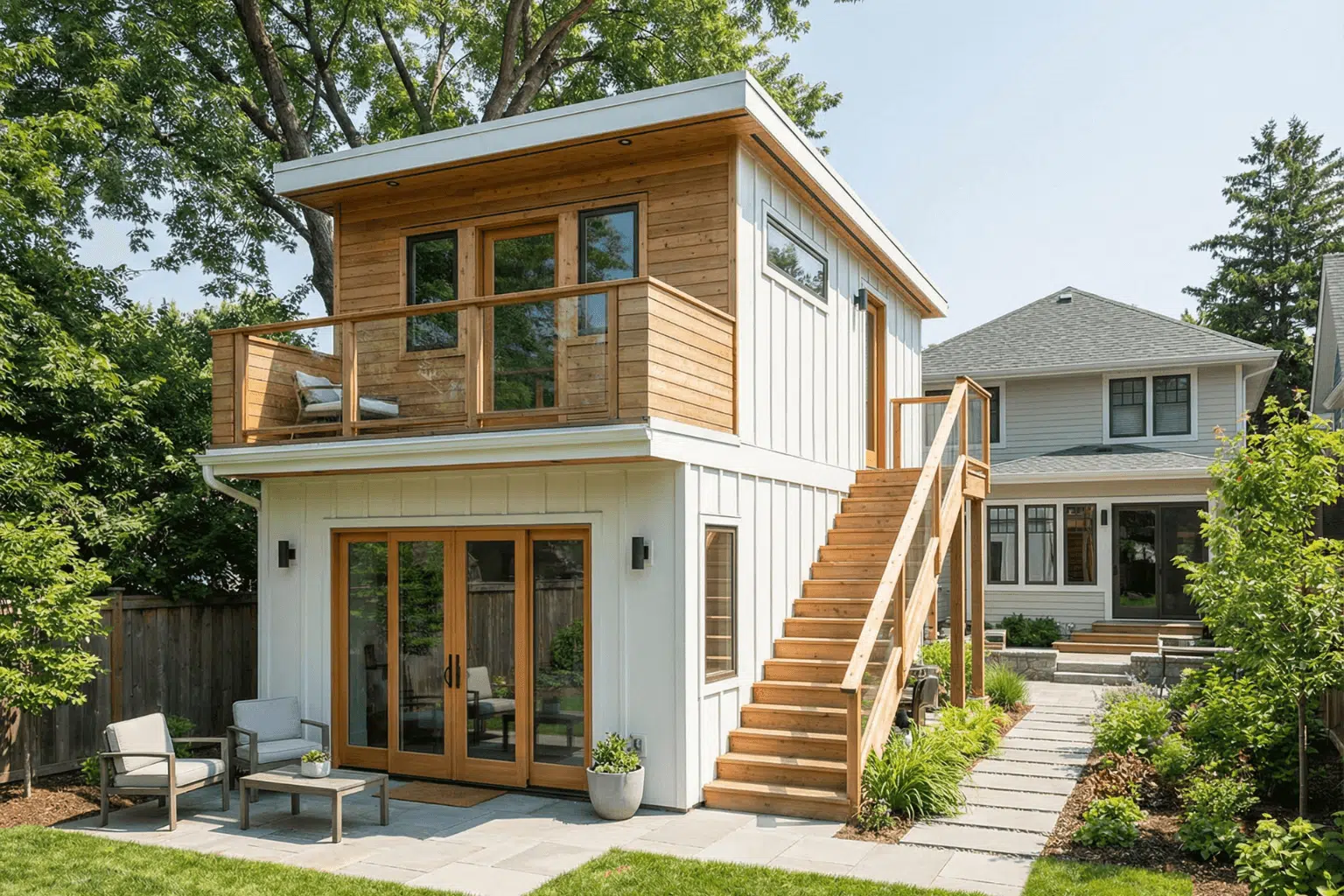

Architecturally, two-story ADUs also give designers more to work with. A double-height entry, a Juliet balcony, a roofline with real presence — these are things that make a structure look intentional and permanent rather than tacked-on. Done right, a two-story ADU doesn’t feel like an accessory to your property. It feels like a feature of it.
These are also particularly well-suited for multigenerational living situations. Grandma gets the ground floor — easy access, no stairs, everything within reach. The adult kids visiting for the weekend take the upstairs. Everybody has space, nobody’s sharing a bathroom with someone they don’t want to, and the main house stays sane. It’s an elegant solution to a very common logistical puzzle.
The "Industrial Loft" Conversion
Got a detached garage that’s seen better days? One that currently serves as a graveyard for holiday decorations, exercise equipment you use twice a year, and approximately 40 boxes labeled “miscellaneous”? We have very good news for you.
The industrial loft aesthetic is absolutely killing it right now, and garage conversions are the perfect canvas for it. We’re talking exposed wooden beams that add warmth and character, polished concrete floors that are simultaneously low-maintenance and undeniably cool, and that “Brooklyn-meets-Arts-District” vibe that feels urban and alive without trying too hard.


Lighting is everything in this style. Edison bulbs are a classic move, but the really interesting spaces are layering different light sources — a statement pendant over the kitchen island, recessed lighting for general ambiance, floor lamps in the living area that warm up the concrete and metal surfaces at night. The goal is a space that feels gritty and refined at the same time, which sounds contradictory until you’re standing in one and you totally get it.
The exposed-structure aesthetic also has a practical bonus: it’s forgiving. Raw materials don’t show wear the way delicate finishes do. Polished concrete gets better with age. Steel fixtures develop character. You’re essentially building a space that’s designed to look lived-in, which means it actually looks better as it gets used. For a rental unit, that’s a genuinely smart investment.
Garage conversions are also the most cost-effective ADU option in LA — you’ve already got the foundation, the walls, and the roof. You’re essentially doing an interior transformation rather than a ground-up build, which keeps the budget considerably more manageable. And when done right, the result photographs ridiculously well for Airbnb listings. Like, “$4,000-a-month-in-Downtown-LA” level well. Which, come to think of it, is probably what you’ll be charging.
The "Wellness Sanctuary"
Post-pandemic, the idea of a dedicated personal wellness space has gone from luxury to — for a growing number of people — genuine necessity. And the ADU format is basically perfect for it.
We’re building full home gyms with rubber flooring, mirrored walls, and proper ventilation for people who are done paying $200 a month to fight over equipment at a crowded LA Fitness. We’re building yoga studios with bamboo floors, built-in sound systems, and that specific quality of diffused natural light that makes a 6am practice feel actually peaceful rather than just early.
The real showstoppers, though, are the wellness ADUs that incorporate infrared saunas. These have exploded in popularity over the last couple of years — the health community’s obsession with heat therapy has officially crossed over into mainstream design, and people are building them into their ADUs as a permanent fixture rather than a standalone purchase. Pair that with a cold plunge setup (yes, people are absolutely doing this), an outdoor shower, and a small meditation room, and you’ve essentially built yourself a private spa that’s 30 seconds from your kitchen.


The smart design move here — especially if you ever want to use the space as a guest suite — is incorporating a Murphy bed. With the right built-in cabinetry, a Murphy bed disappears into the wall during the day, leaving your yoga studio or creative space completely functional. Then when your in-laws visit, you flip a bed down and suddenly you have a proper guest room. Flexible square footage is LA real estate gold, and this is one of the cleverest ways to achieve it.
These wellness-focused builds are particularly popular in the Hollywood Hills and Brentwood areas, where buyers have higher expectations for their properties and the outdoor integration possibilities are genuinely stunning.
What All These Trends Have in Common
Look at the trends above and you’ll notice something: none of them are purely about aesthetics. Each style is solving a real problem — too much noise, too many utility bills, too little space, too few boundaries, too much stress — while also looking incredible in the process.
That’s the through-line. That’s what separates a great ADU from one that just takes up space.
Whether you’re vibing with minimalist Japandi or industrial chic, the best ADU contractors Los Angeles has to offer (again, hi) know that great design means several non-negotiable things:
Functionality first. Pretty is genuinely pointless if the space doesn’t work for your actual life. A beautiful kitchen with zero counter space is just a frustrating kitchen with great lighting. The design has to serve the humans using it, every single day.
Quality materials. Trendy finishes are only trendy if they survive contact with real life. That means flooring that handles foot traffic, surfaces that don’t show every mark, and fixtures that still work properly five years from now. Cutting corners on materials to hit a budget number is one of the most common ADU regrets we hear about.
Timeless bones. Trends come and go. The structural and architectural decisions you make today need to hold up when the current aesthetic moment has passed. Good proportions, strong rooflines, thoughtful window placement — these things never look dated because they’re grounded in fundamentals, not fashion.
Your personal style. Not just what’s “in,” but what genuinely makes you happy to walk into every single day. Because at the end of the day, this is your property, and you’re going to be looking at this structure for decades. It should feel like you, not like a mood board you half-heartedly adopted from Instagram.
Your ADU is an extension of your main home. It should complement your property’s aesthetic while having its own distinct character — which is honestly a harder design challenge than it sounds. That’s where professional CAD designs and experienced architects really earn their keep. They make sure your backyard cottage or garage conversion feels cohesive with the rest of your property while still being special enough to stand on its own.
Getting that balance right is what turns a good ADU into a great one. And in Los Angeles in 2026, great is absolutely the standard worth shooting for.
Choosing the Right ADU Contractor in Los Angeles
Here’s the thing about LA — everyone’s got a guy. A cousin who does construction. A neighbor who swears by some contractor they found on Craigslist. And look, maybe that works out great. Or maybe you end up six months behind schedule with a half-built structure in your backyard and a phone number that’s suddenly going to voicemail.
Building an ADU is a serious investment. We’re talking permits, engineering, design, city approvals, and actual construction — all of which need to go right, in the right order, with the right people handling each piece. That’s not the project to experiment with.
Companies like Precise Building and Restoration exist precisely for this reason. We know the LA permitting landscape inside and out, we’ve seen every curveball a backyard build can throw, and we bring the kind of end-to-end expertise that turns a stressful process into a smooth one. From the first CAD design to the final walkthrough, you want a team that’s done this hundreds of times — not one that’s figuring it out alongside you.
The right ADU contractor in Los Angeles doesn’t just build your ADU. They protect your investment, keep your timeline honest, and make sure what ends up in your backyard actually matches what you envisioned. In a city full of options, that’s worth choosing carefully.
Share the Post:
Related Posts
Large-Format Tile vs. Mosaic Tile for a Shower Floor
October 20, 2026
Vinyl vs. Fiberglass vs. Aluminum-Clad Windows
October 19, 2026
Let's Build Something Amazing Together
No pressure, no pushy sales tactics — just an honest conversation about your project. Tell us what you're thinking, and we'll show you how we can make it happen.