ADU Contractors Los Angeles: Your Backyard Goldmine Awaits (And We Know How to Build It)
AI Summary
- Cost Reality: Expect $180,000-$380,000 for quality builds (garage conversions start at $80,000). Additional costs include permits ($8,000-$25,000), plans ($8,000-$20,000), and utilities ($5,000-$15,000).
- Timeline: 9-18 months total (2-6 months for permits alone, 5-9 months construction).
- ROI Potential: ADUs increase property value by 20-35% and generate $2,400-$3,200/month in rental income in Los Angeles markets.
- 2026 Design Trends: Japandi minimalist (up 67%), climate-conscious smart ADUs, modern farmhouse, two-story builds, and wellness sanctuaries dominate current requests.
- Real-Life Uses: Aging parents housing, divorce co-parenting arrangements, adult children unable to afford LA rent, multigenerational family living, work-from-home offices, and Airbnb income.
- Choosing Contractors: Work with ADU contractors Los Angeles who handle permits, engineering, and design in-house.
Let’s talk about the elephant in the room—or should I say, the potential rental unit in your backyard.
You’ve got that awkward patch of grass collecting tumbleweeds, a garage that’s basically a deluxe storage unit for stuff you haven’t touched since 2019, or maybe just dead space that’s literally doing nothing but existing. Meanwhile, Los Angeles real estate prices are doing their best impression of SpaceX rockets (fun fact: the median LA home price hit $925,000 in early 2026, up 6.2% from last year).
Here’s where it gets interesting: Accessory Dwelling Units (ADUs) aren’t just the hottest trend since avocado toast—they’re your ticket to extra income, multigenerational living, or finally having that wine cellar/home theater/secret lair you’ve been dreaming about.
But here’s the catch. Building an ADU in Los Angeles without the right team is like trying to navigate the 405 during rush hour… blindfolded… on a unicycle. Permits, city approvals, engineering nightmares, contractors who ghost you faster than a bad Tinder date—it’s enough to make anyone want to just keep that tumbleweeds-and-forgotten-Christmas-decorations situation going.
Enter Precise Building & Restoration.
We’re not just ADU contractors in Los Angeles. We’re the people who take your project from “I have a cool idea” to “Holy smokes, I can’t believe this is actually mine” without you losing sleep, sanity, or your faith in humanity. Excellence, precision, and integrity aren’t just buzzwords we slap on our website—they’re literally how we’ve stayed in business for over 35 years.
And yeah, we’re family-owned, which means when you work with us, you’re not dealing with some faceless corporation. You’re working with people who actually care whether your backyard cottage looks like a luxury retreat or a glorified shed.
Table of Contents
Why You Actually Need an ADU (Beyond Just "It Sounds Cool")
Okay, let’s get real about why working with ADU contractors Los Angeles homeowners trust isn’t just about jumping on a trend. It’s about solving actual problems that real people face every single day in one of the most expensive cities in America.
The Financial Game-Changer
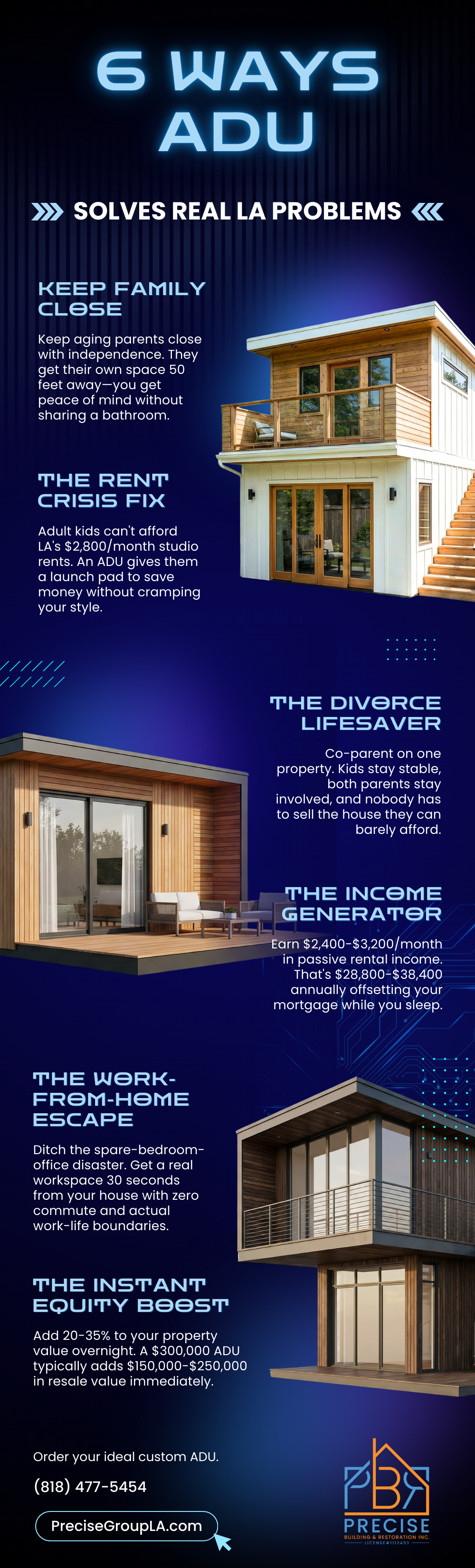
Let’s talk cold, hard cash. The average ADU in Los Angeles rents for $2,400-$3,200 per month in 2026. That’s $28,800 to $38,400 annually in passive income. Run those numbers over 10 years and you’re looking at $288,000 to $384,000 in rental income that could pay off the construction costs and then some.
But here’s where it gets spicy: your property value increases by an average of 20-35% with a well-built ADU. So you’re not just getting rental income—you’re literally increasing your net worth while you sleep. It’s like having a money printer in your backyard, except legal and way more stylish.
Plus, let’s be honest: mortgage rates in 2026 are still making people’s eyes water (hovering around 6.5-7% for conventional loans). An ADU can help offset that monthly nut in ways that make your accountant send you heart-eye emojis.
The "My Parents Need Me But I Also Need My Sanity" Solution
Here’s a scenario playing out in thousands of LA homes right now: Your parents are getting older. They need help but aren’t ready for assisted living (and honestly, have you seen the costs? $6,000-$9,000 per month for decent facilities in LA). Moving them into your house sounds great until you remember that you’re 50 years old and having your mom critique your cooking is… a vibe you left behind in 1995.
Enter the ADU.
Mom and Dad get their independence, their own space, their own kitchen where they can judge your meal choices from afar. You get peace of mind knowing they’re 50 feet away if anything happens. It’s the perfect balance of proximity and boundaries—something every family therapist in America would applaud.
And this isn’t just a white suburban thing. Multi-generational living has always been the norm in Latino and Asian family models. In 2026, over 43% of Asian American households and 38% of Latino households in LA are multigenerational. The ADU is just the modern architectural answer to a timeless cultural value: keeping family close.
The Divorce ADU: Co-Parenting Without Losing Your Mind (Or Your Property)
Plot twist: One of the fastest-growing ADU use cases in 2026? Divorced couples who are co-parenting and can’t afford to maintain two separate LA properties. (Because let’s be real—if you could barely afford one LA mortgage, two is basically financial fan fiction.)
The “nesting” arrangement where one parent lives in the main house, the other in the backyard ADU, and the kids stay put? It’s genius. The kids don’t have to pack a bag every week, shuffle between neighborhoods, or lose friends because Mom moved to the Valley. Both parents stay involved. Everyone keeps their equity.
Is it for everyone? No. But for families prioritizing stability for their kids while navigating the brutal reality of LA real estate prices, it’s a legitimate solution. And yes, we’ve built several of these. No judgment, just exceptional construction.
The "My Adult Kids Can't Afford LA Rent" Reality
Remember when moving out at 22 was just… what people did? LOL, 2026 called—that’s adorable.
The average one-bedroom apartment in LA now rents for $2,800/month. Your kid just graduated with $60,000 in student loans and an entry-level salary that makes you wonder if college was actually worth it. Moving back home makes financial sense, but let’s be honest: everyone’s too old to share a bathroom and argue about whose turn it is to unload the dishwasher.
An ADU gives your adult children a launching pad. They’re close enough for family dinners (and let’s be real, to do their laundry). You can charge them below-market rent—or no rent—while they save for their own place, build their career, or figure out this whole “adulting” thing.
Plus, when they do move out (because eventually they will… probably), you’ve got a rental unit that immediately starts generating income. It’s a win-win that doesn’t involve anyone sleeping on a futon in your living room.
The Work-From-Home Revolution That's Not Going Away
Hot take: Remote work isn’t a pandemic thing anymore. It’s a permanent cultural shift. In 2026, 42% of LA’s workforce works remotely at least part-time. Your spare bedroom-turned-office isn’t cutting it anymore, especially when “office” means “laptop on bed with terrible posture and Zoom meetings interrupted by your teenager’s TikTok sounds.”
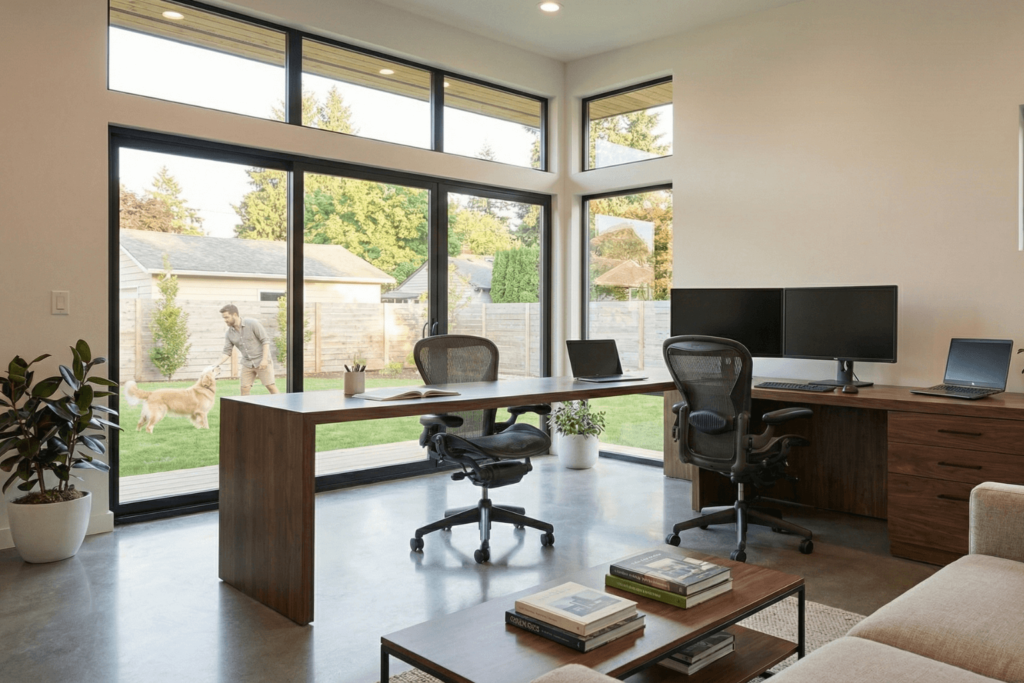
A backyard office ADU is the adult version of a tree house. It’s your space. Professionally designed, properly sound-insulated, with actual ergonomic furniture and lighting that doesn’t make you look like a horror movie extra on video calls. Commute? Thirty seconds across your yard. Dress code? Whatever makes you productive.
And here’s the kicker: a dedicated home office ADU is potentially tax-deductible as a business expense. Talk to your CPA, but the IRS looks way more favorably on a separate structure used exclusively for work than on “the corner of my bedroom that has a desk.”
The Creative Studio, Wellness Retreat, or "I Just Need Space" Solution
Not everything needs to be about money or family logistics. Sometimes you just want a space that’s yours.
- Artists are building backyard studios where they can paint at 2 AM without waking anyone up
- Musicians are creating sound-proofed recording spaces (no more complaints from neighbors about drum practice)
- Writers are building quiet retreats where the only interruptions are intentional
- Fitness enthusiasts are creating personal gyms that beat any LA Fitness membership
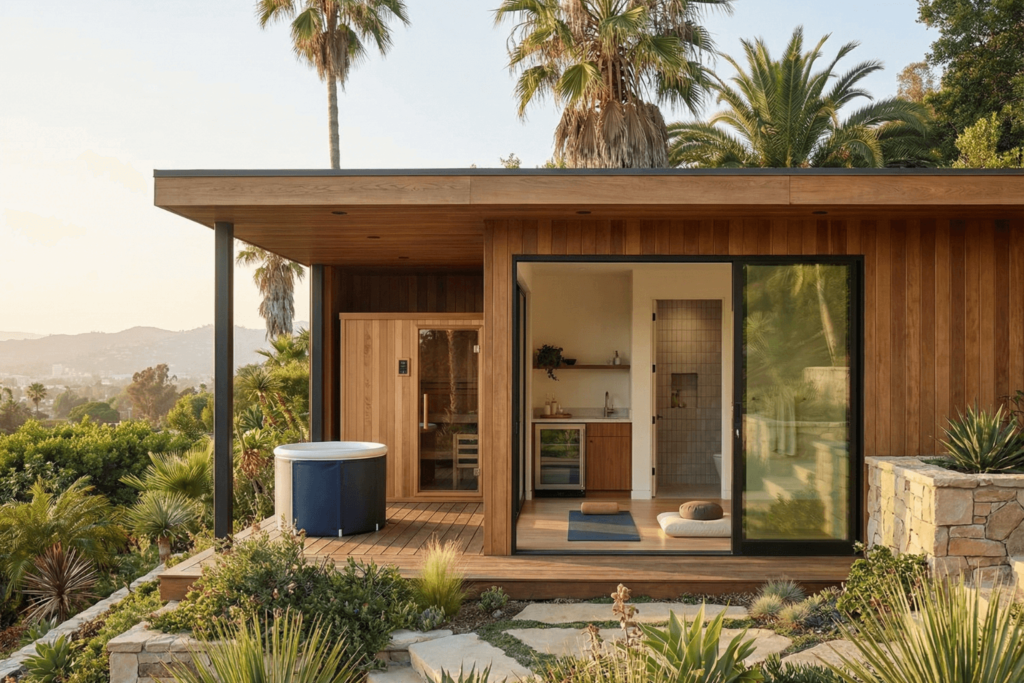
- Wellness junkies are building yoga studios/meditation spaces/infrared sauna combinations that are basically day spas
One client told us, “I love my family, but I also love having a place where I can close the door and nobody asks me for snacks or where their soccer cleats are.” Poetry.
The Short-Term Rental Goldmine
If you’re in an Airbnb-friendly zone, here’s where things get interesting. A well-designed luxury guest house can command $150-$300 per night in desirable LA neighborhoods. Do the math: even at 50% occupancy (very conservative), you’re looking at $2,250-$4,500 per month. And unlike long-term rentals, you maintain control, can use the space yourself when needed, and can adjust rates for peak seasons.
Plus, in 2026’s experience-economy, travelers want authentic neighborhood experiences, not another generic hotel room. A beautifully designed ADU in Silver Lake, Echo Park, or Venice? That’s the vibe people are paying premium prices for.
Why This Matters for Choosing the Right Contractors
Here’s the thing: whatever your reason for building an ADU—income, family, sanity, creativity—you need ADU contractors in Los Angeles who understand that this isn’t just a construction project. It’s solving a real problem in your actual life.
We’ve built ADUs for aging parents who needed grab bars and wheelchair accessibility. We’ve built divorce ADUs where both parents wanted input on the design. We’ve built creative studios with specific acoustics and lighting. We’ve built rental units designed to photograph beautifully for Airbnb listings.
Every project is different because every family’s story is different. And that’s exactly why cookie-cutter solutions don’t work—and why our “Ground Zero to Completion” approach, with professional CAD designs tailored to your specific needs, makes all the difference.
Your backyard isn’t just empty space. It’s potential. Let’s unlock it.
What Does an ADU Actually Cost in Los Angeles? (The 2026 Real Talk Edition)
Alright, let’s address the elephant-sized question: “How much is this going to cost me?”
We get it. You’re not looking for vague “it depends” answers. You want numbers. Real numbers. So here’s the brutally honest breakdown of what ADU contractors in Los Angeles are charging in 2026 for different project types.
Keep in mind: These are quality builds with premium materials from licensed, insured contractors who actually show up. If someone quotes you significantly less, ask yourself what corners they’re cutting (spoiler: probably all of them).
ADU Construction Costs by Type:
ADU Type | Size | Cost Range | What You Get | Best For |
Basic Garage Conversion | 400–600 sq ft | $80,000 – $150,000 | Converting existing detached garage into studio-style ADU. Studio/1 bed, 1 bath, kitchenette, standard finishes. | Budget-conscious builds, rental units, starter projects |
One-Story, One-Bedroom | 600–800 sq ft | $180,000 – $280,000 | Ground-up new construction. 1 bed, 1 bath, full kitchen, living area. Mid-range finishes, energy-efficient windows, proper insulation. | Aging parents, long-term rentals, young adult children |
One-Story, Two-Bedroom | 800–1,000 sq ft | $250,000 – $380,000 | Spacious layout. 2 beds, 1–2 baths, full kitchen, dedicated living/dining area. Quality finishes, upgraded appliances, smart home features. | Families, co-parenting situations, premium rental income |
Two-Story | 1,000–1,200 sq ft | $320,000 – $480,000 | Two levels. Typically 2–3 beds, 2 baths, full kitchen downstairs, bedrooms upstairs. Higher-end finishes, great storage, small deck/balcony. | Small lot owners going vertical, multi-generational living, maximizing rental value |
Luxury / Custom | 1,200+ sq ft | $500,000 – $750,000+ | High-end everything — designer fixtures, Wolf/Sub-Zero appliances, custom millwork, spa bathrooms, smart home automation, architectural details. | Homeowners wanting a structure rivaling their main house, luxury Airbnb, high-end guest accommodations |
Pre-Fab / Modular | Variable | $120,000 – $250,000 | Factory-built units delivered and installed. Faster timeline: 8–12 weeks vs. 6–9 months for traditional builds. | Those who prioritize speed over customization |
Additional Costs Beyond Construction (AKA The Stuff People Forget About):
Here’s where many contractors conveniently “forget” to mention costs until you’re already committed. Not us. Transparency is sexy.
Permits & City Approvals
- Cost Range: $8,000 – $25,000
- What It Covers: Plan check fees, building permits, utility connection permits, impact fees (varies by LA neighborhood—some cities charge more than others)
- Timeline: 2-6 months (yes, really—LA bureaucracy moves at the speed of continental drift)
- Our Take: We handle this entire nightmare for you. You’re welcome.
Architectural & Engineering Plans
- Cost Range: $8,000 – $20,000
- What It Covers: Professional CAD designs, structural engineering, energy compliance calculations, site surveys
- Why It Matters: The city won’t even look at your permit application without these
- Our Bonus: Remember, your first three designs are FREE with us. That’s $8K-$20K you’re saving right there.
Utility Connections
- Cost Range: $5,000 – $15,000
- What It Covers: Connecting water, sewer, electrical, and gas lines from your main house to the ADU. Sometimes requires trenching, new panels, meter upgrades.
- The Surprise Factor: Old homes with outdated electrical panels? You might need a full panel upgrade for the main house too—add another $3K-$8K.
Site Preparation & Foundation
- Cost Range: $10,000 – $35,000
- What It Covers: Demolition (if needed), grading, excavation, concrete foundation, drainage systems
- Variable Costs: Sloped lots cost more. Awkward access? More expensive. Tree removal? Add $1K-$5K per tree.
Landscaping & Hardscaping
- Cost Range: $5,000 – $25,000
- What It Covers: Pathways to the ADU, replacing torn-up landscaping, new fencing, outdoor lighting, maybe a small patio
- Pro Tip: Don’t skimp here—a beautiful ADU with a muddy path and dead grass looks sad.
Furniture & Appliances (if renting/Airbnb)
- Cost Range: $8,000 – $25,000
- What It Covers: Beds, sofas, dining table, TV, cookware, linens—everything needed to make it livable
- Skip This If: You’re building for family members who have their own stuff
The Real-Deal Total Investment:
Let’s do the math on a typical one-story, two-bedroom ADU:
- Construction: $300,000
- Permits: $15,000
- Plans/Engineering: $12,000 (but FREE with us!)
- Utilities: $10,000
- Site Prep: $18,000
- Landscaping: $10,000
- Furnishing: $15,000 (if renting)
Grand Total: $380,000
Sounds like a lot? It is. But remember: you’re adding $150,000-$250,000 in property value, and if you rent it at $3,000/month, you’re looking at a 9.5% annual return on investment before tax benefits. Try getting that from a savings account in 2026 (current rates: a laughable 1.5-2%).
Why Cost Transparency Matters When Choosing ADU Contractors Los Angeles
Here’s the thing: the most trusted ADU contractors in Los Angeles don’t play games with pricing. We give you itemized proposals with everything spelled out. No “unforeseen circumstances” that magically add 30% to your bill halfway through.
When someone quotes you $150K for a two-bedroom ADU and it sounds too good to be true? It is. They’re either:
- Cutting corners on materials
- Not properly licensed/insured
- Planning to hit you with change orders for “extras” (that should’ve been included)
- All of the above
We’ve seen too many homeowners get burned by lowball bids that turn into financial nightmares. Our approach? Detailed, transparent, realistic pricing from day one. You know exactly what you’re investing and exactly what you’re getting.
Because building an ADU is already stressful enough without surprise bills making you question every life choice that led to this moment.
What's Hot in Los Angeles ADU Design for 2026 (Spoiler: Your Neighbors Are Getting Creative)
Let’s talk trends, because if you’re investing six figures into a backyard structure, you want it to look current, not like a time capsule from 2019.
The ADU contractors in Los Angeles who actually know what they’re doing (hi, that’s us) are seeing some seriously cool design movements right now. Here’s what’s dominating the scene:
The "Japandi" Minimalist ADU
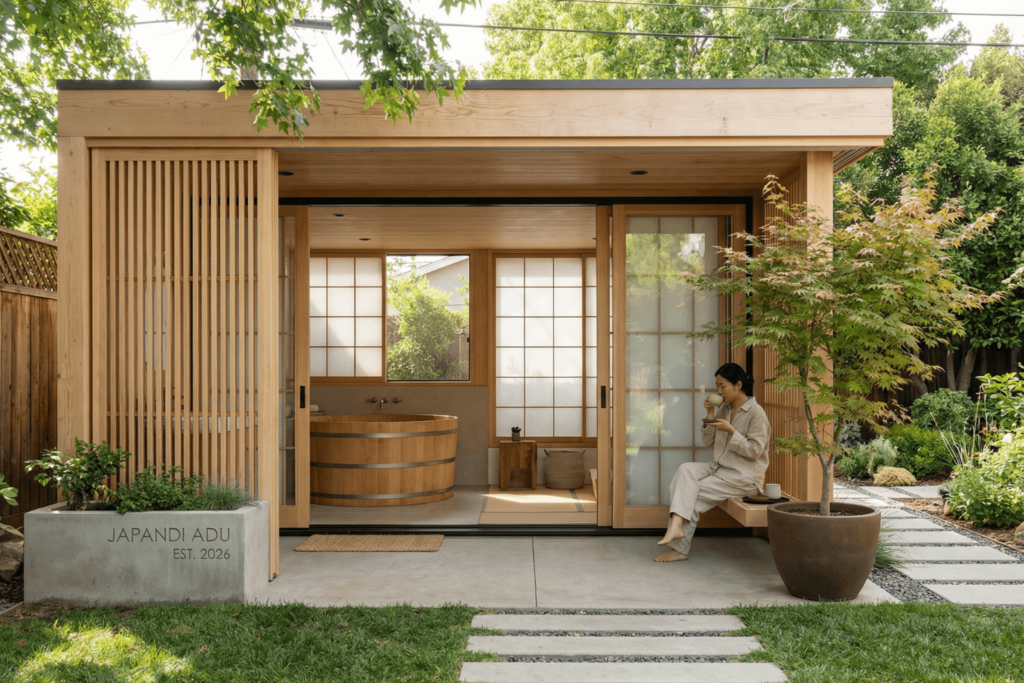
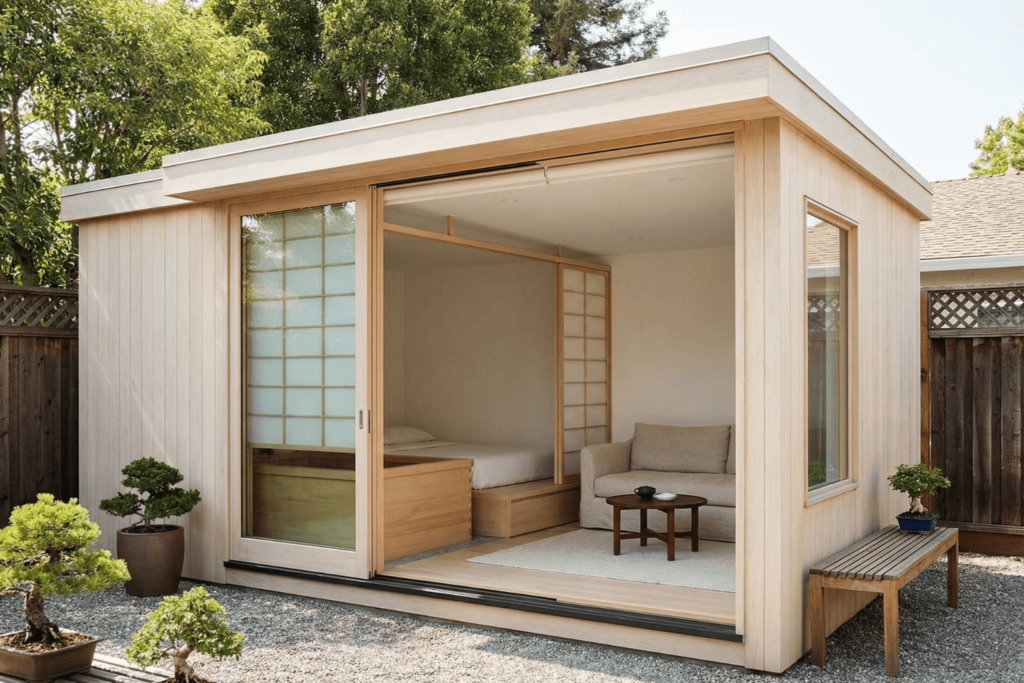
Japanese aesthetics meet Scandinavian simplicity, and the result is chef’s kiss. Think clean lines, natural materials, and that “calming zen retreat” vibe that makes you forget you’re still technically in LA. We’re talking soaking tubs, shoji-inspired screens, and indoor-outdoor flow that would make a Zen master jealous. This style crushed it in 2025 and shows no signs of slowing down—requests for Japandi-style ADUs are up 67% in the first quarter of 2026.
The "Climate-Conscious" Smart ADU
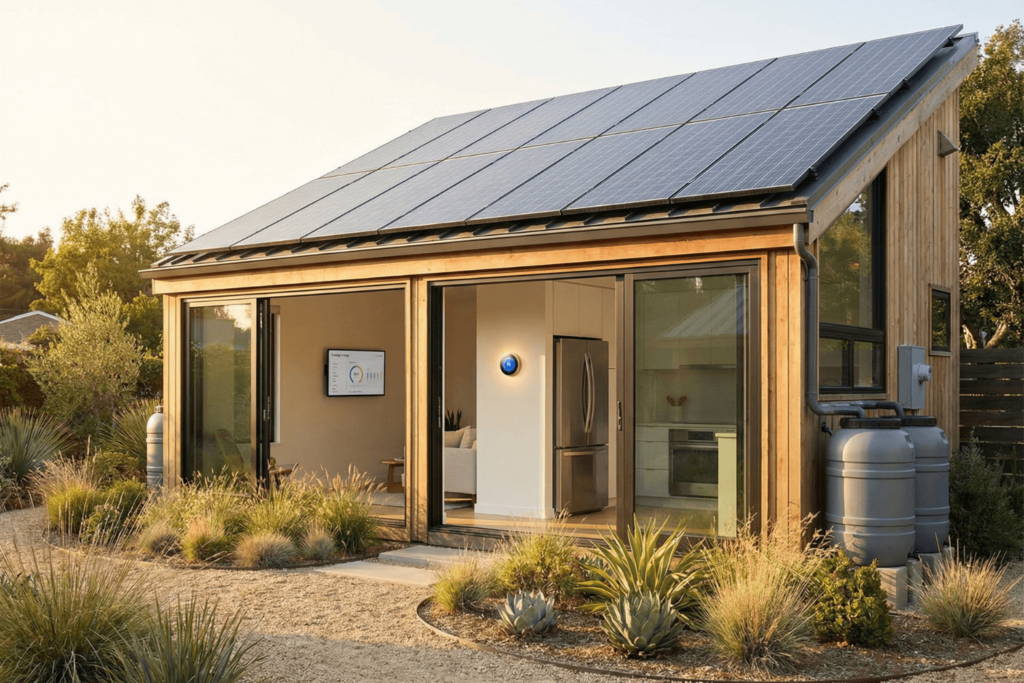
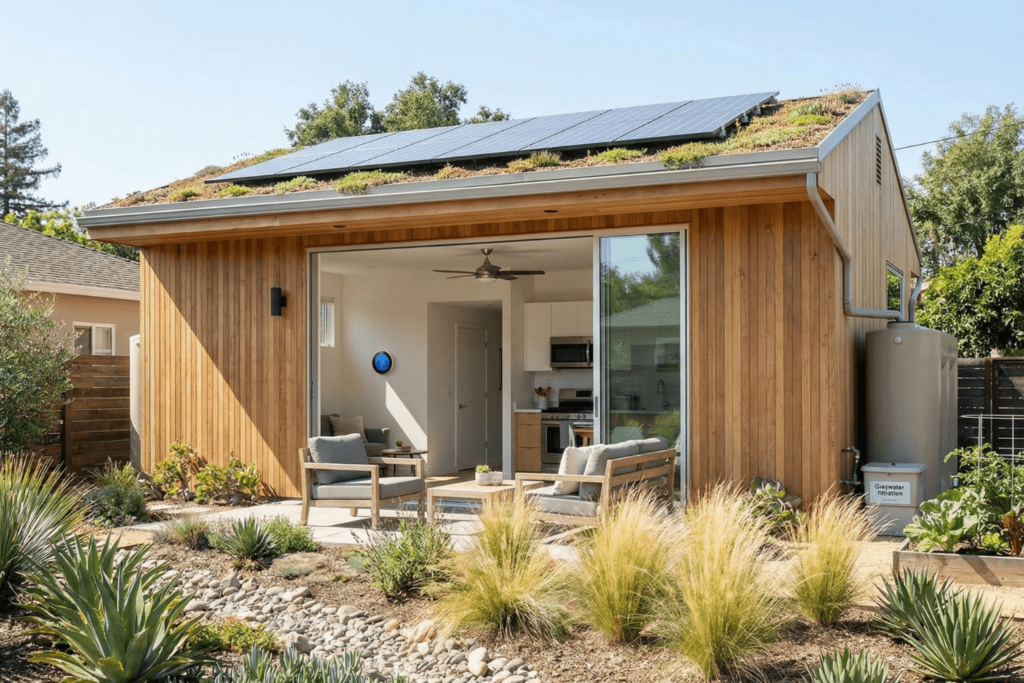
Welcome to the future, where your backyard cottage knows the temperature before you do. Solar panels aren’t just trendy—they’re practically standard in luxury ADU builds now. Add in smart thermostats, greywater systems, drought-resistant landscaping, and energy-efficient appliances, and you’ve got an ADU that’s basically giving Mother Nature a high-five. Fun fact: Energy-efficient ADUs in LA are commanding 15-20% higher rental rates in 2026 because everyone wants to feel good about their carbon footprint (while also saving on utilities).
The "Modern Farmhouse" That's Not Trying Too Hard
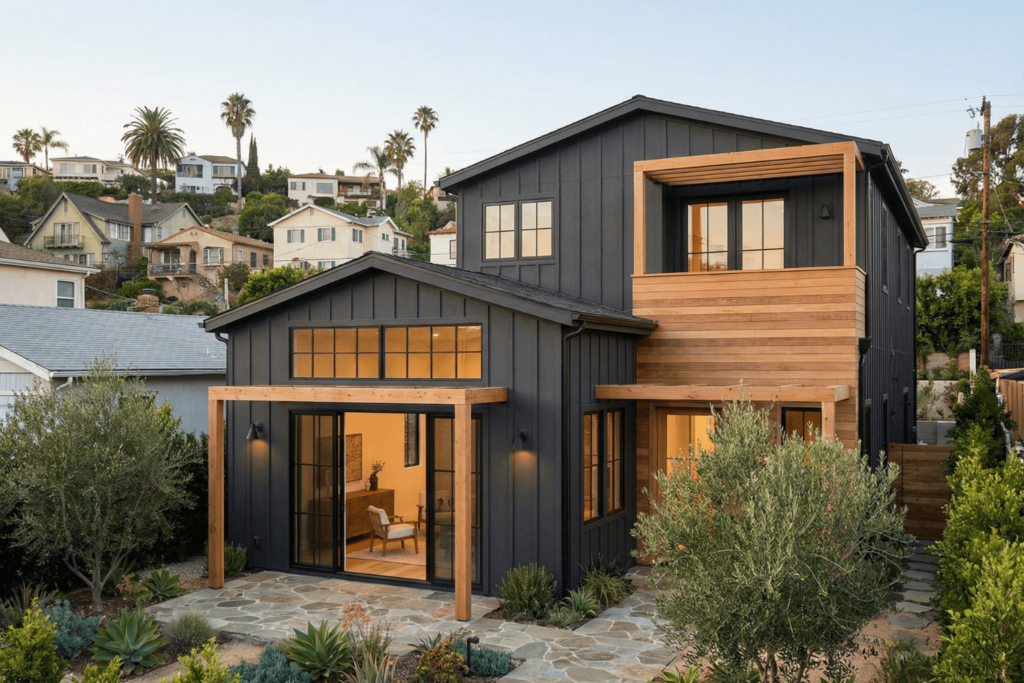
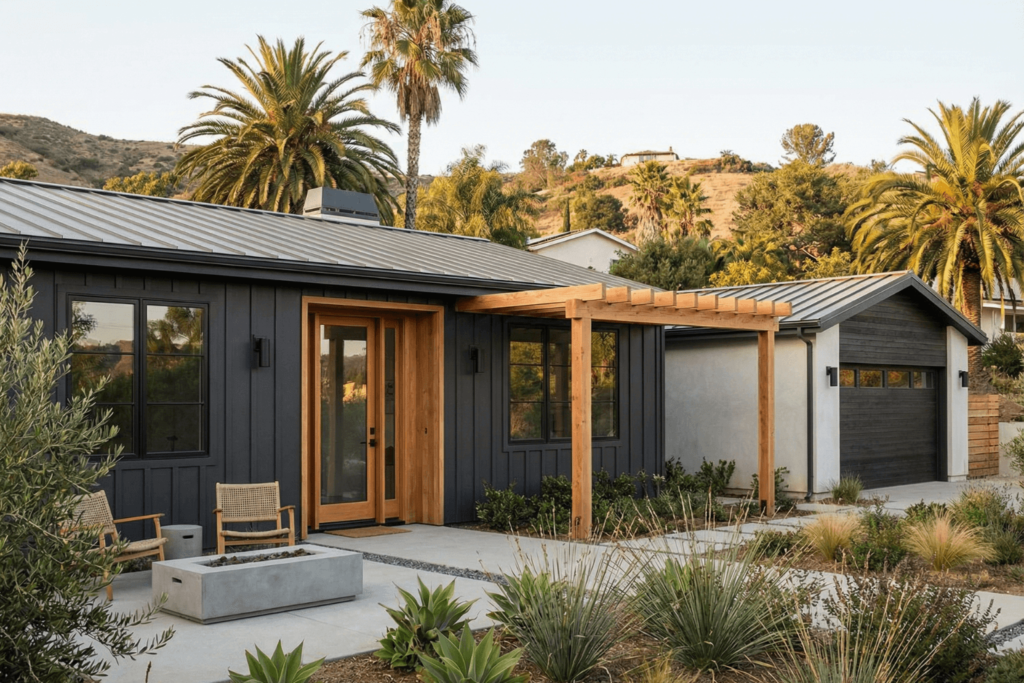
Shiplap had its moment. We’ve evolved. The 2026 version of modern farmhouse is more sophisticated—board-and-batten siding, black-framed windows, warm wood accents, but with contemporary proportions that don’t scream “I got all my ideas from Pinterest circa 2018.” It’s cozy without being cutesy, and it pairs beautifully with LA’s diverse architectural landscape.
The "Two-Story Stunner"
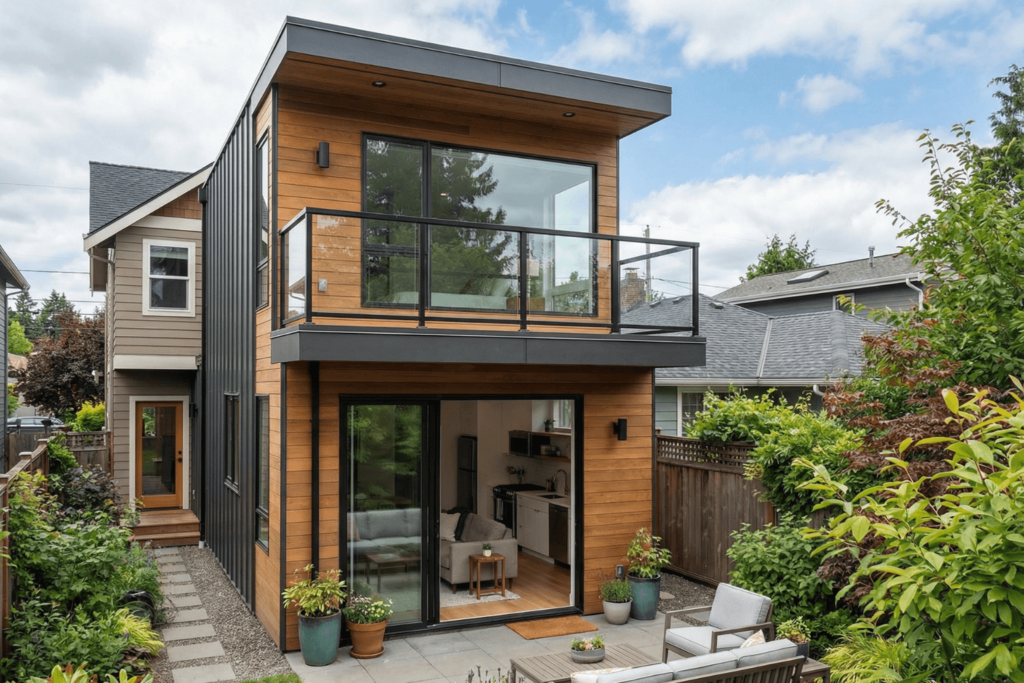
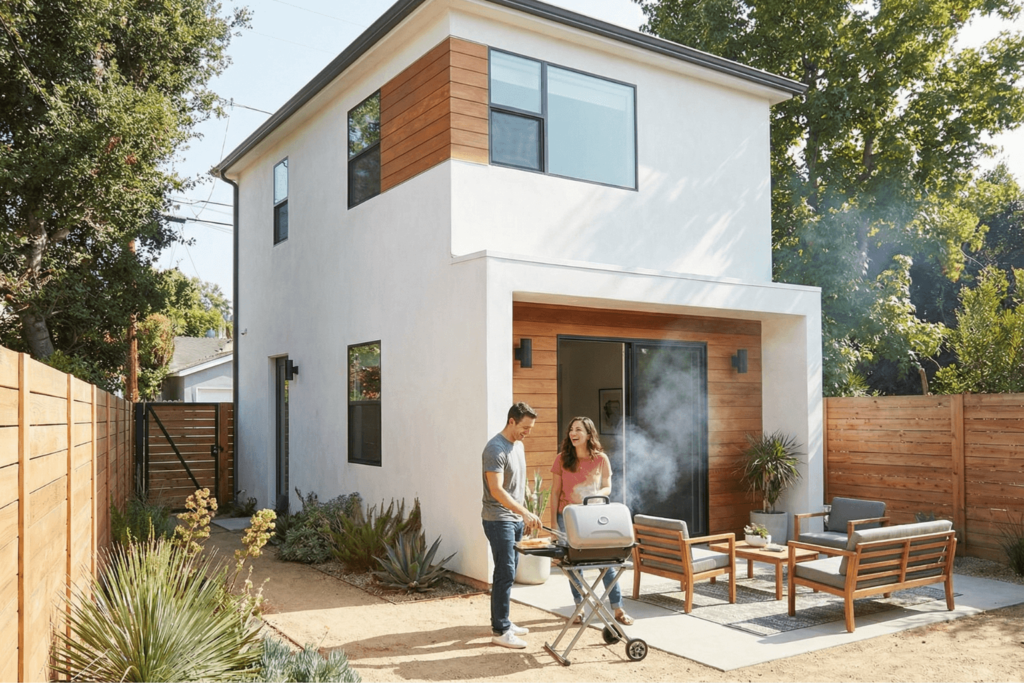
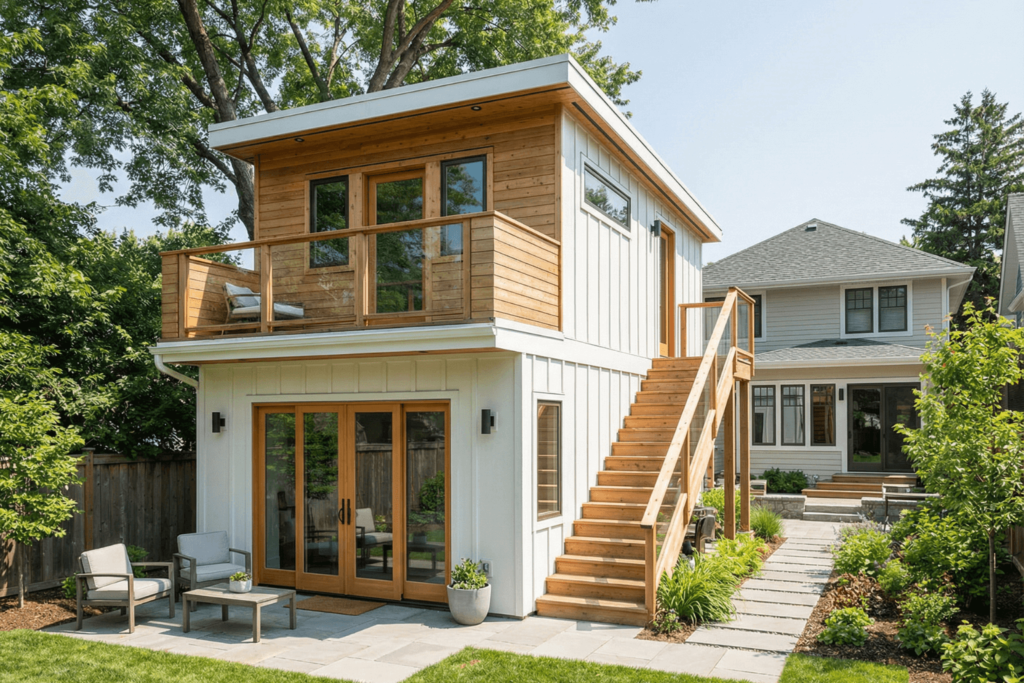
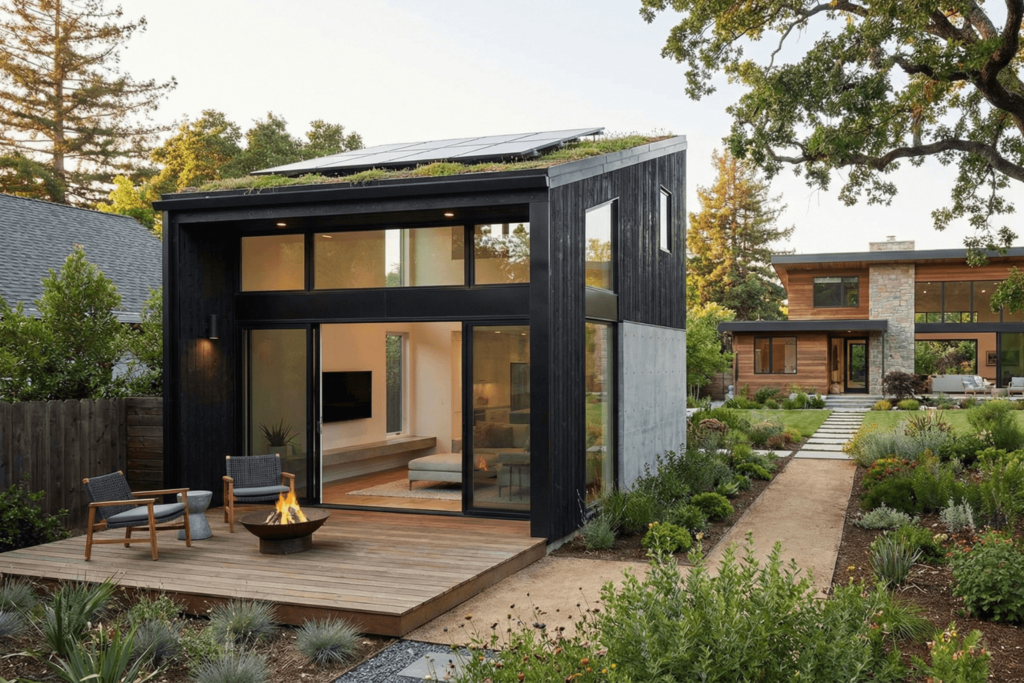
Thanks to updated ADU regulations, going vertical is back on the menu. Two-story ADUs are having a major moment, especially on smaller lots where you need to maximize square footage without eating up the entire backyard. Ground floor for living spaces, second floor for bedrooms with views—it’s like having a tiny luxury apartment that just happens to be behind your main house. Bonus: These are perfect for multigenerational living when grandma needs her own space but you want her close.
The "Industrial Loft" Conversion
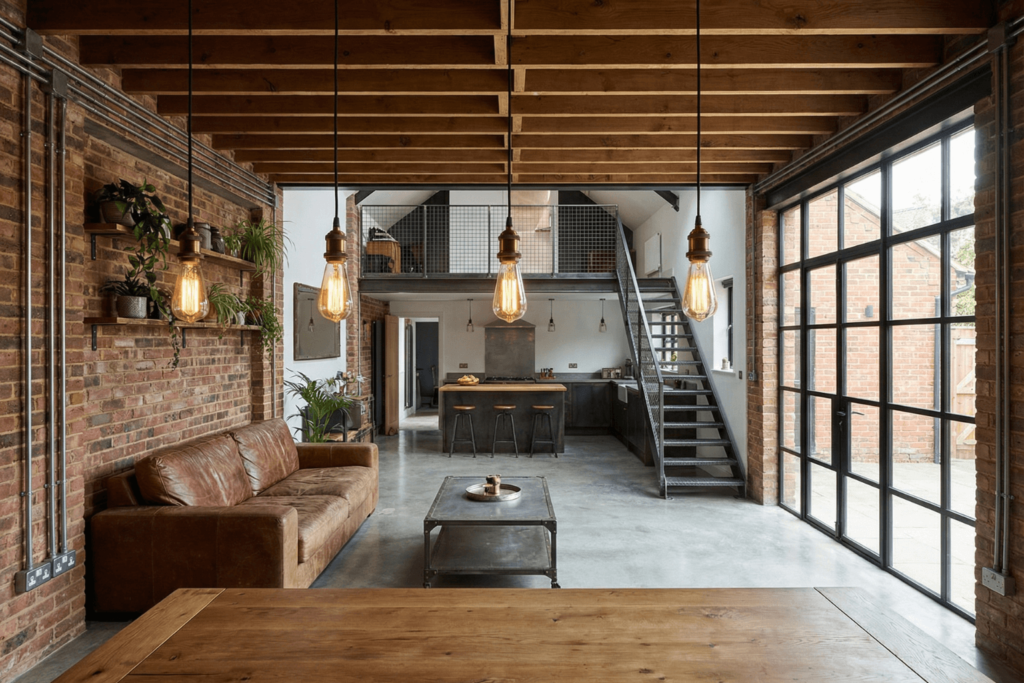
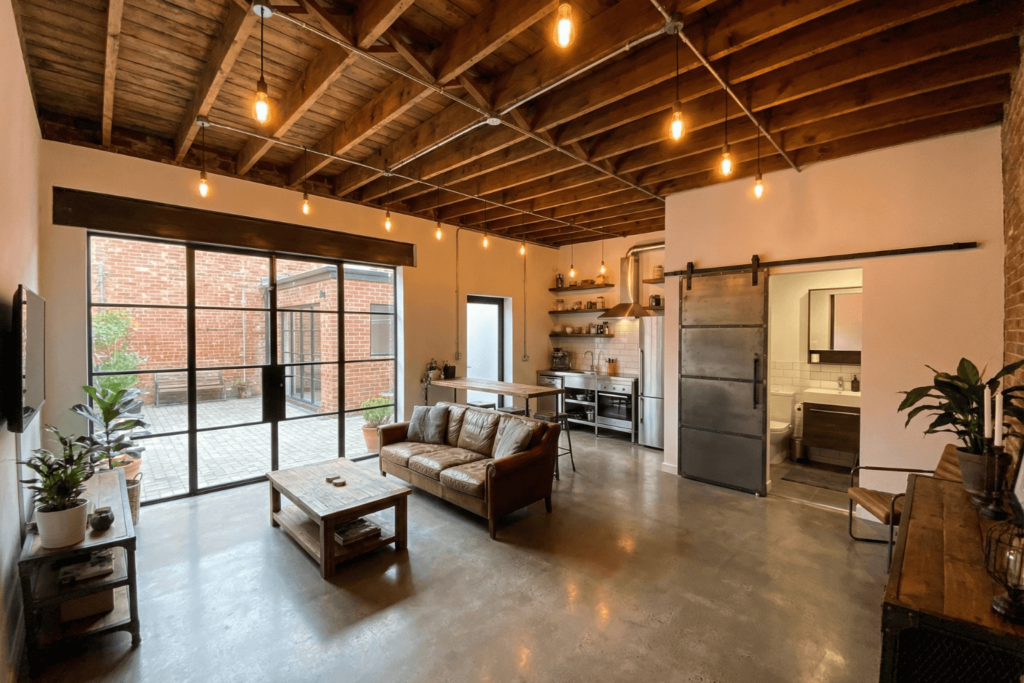
Got a detached garage that’s seen better days? The industrial loft aesthetic is absolutely killing it right now. Exposed beams, polished concrete floors, Edison bulbs, and that “Brooklyn-meets-Arts-District” vibe. It’s urban, it’s edgy, and it photographs ridiculously well for Airbnb listings (just saying). Garage conversions are the most cost-effective ADU option, and when done right, they look like something you’d pay $4,000/month to rent in Downtown LA.
The "Wellness Sanctuary"
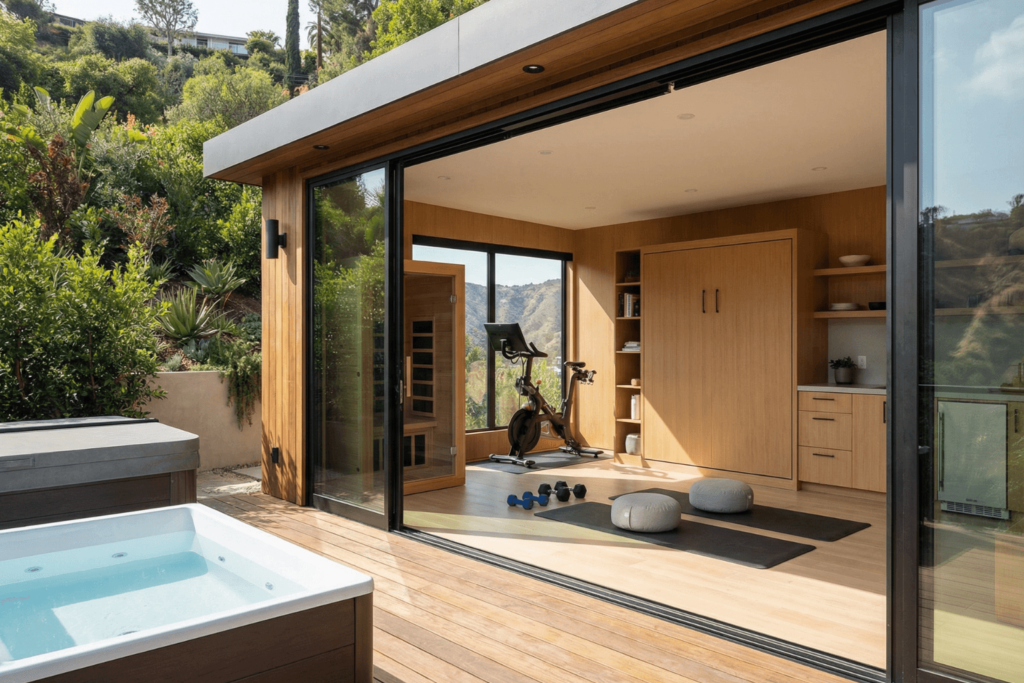
Post-pandemic, everyone’s obsessed with personal wellness spaces. Home gyms, yoga studios, meditation rooms, infrared saunas—we’re building ADUs that are essentially private wellness retreats. Add a Murphy bed and some clever design, and boom: you’ve got a space that serves as your Zen sanctuary during the week and a guest suite on weekends. These luxury guest house builds are particularly popular in the Hollywood Hills and Brentwood areas.
What All These Trends Have in Common
Whether you’re vibing with minimalist Japandi or industrial chic, the best ADU contractors Los Angeles has to offer (again, hi) know that great design means:
- Functionality first – Pretty is pointless if the space doesn’t work for your actual life
- Quality materials – Trendy finishes are only trendy if they last longer than the trend
- Timeless bones – Architectural integrity that won’t look dated in five years
- Your personal style – Not just what’s “in,” but what makes you happy to walk into every day
Remember: Your ADU is an extension of your main home. It should complement your property’s aesthetic while having its own character. That’s where our professional CAD designs and expert architects earn their keep—they make sure your backyard cottage or garage conversion feels cohesive with your property while still being special.
Our "Ground Zero to Completion" Process (AKA The Part Where We Handle Literally Everything)
Here’s where being ADU contractors Los Angeles homeowners actually want to work with really shines.
Most construction companies are like ordering à la carte at a restaurant where nothing comes together and you end up with seven random appetizers and no entrée. You hire one team for permits, another for design, another for engineering, another for the actual build, and suddenly you’re conducting an orchestra of chaos where nobody’s playing the same song.
Not. With. Us.
We handle everything in-house from ground zero to completion. And when we say everything, we mean everything:
What We Handle (So You Don't Lose Your Mind):

Permits & City Approvals
LA's permitting process makes DMV visits look efficient. We navigate the bureaucratic maze so you don't have to. SB 9 (California's game-changing ADU law from a few years back) made things easier legally, but paperwork-wise? Still a nightmare. Good thing nightmares are our specialty.

Engineering
Structural integrity isn't something you want to cheap out on. (Hot take, we know.) Our licensed engineers ensure your luxury guest house won't become a cautionary tale during the next earthquake. California gets about 10,000 earthquakes a year—most tiny, but still. We build like we're expecting "The Big One."

Professional CAD Designs
Created by actual human experts with degrees and everything. Not AI. Not some template from 2003. Real architects who understand that your vision for a backyard cottage should look like so

The Actual Construction
With premium materials that'll last decades, not just until your first inspection.
One team. One point of contact. One company that you can actually hold accountable when your mother-in-law moves into the ADU and has opinions about the kitchen backsplash.
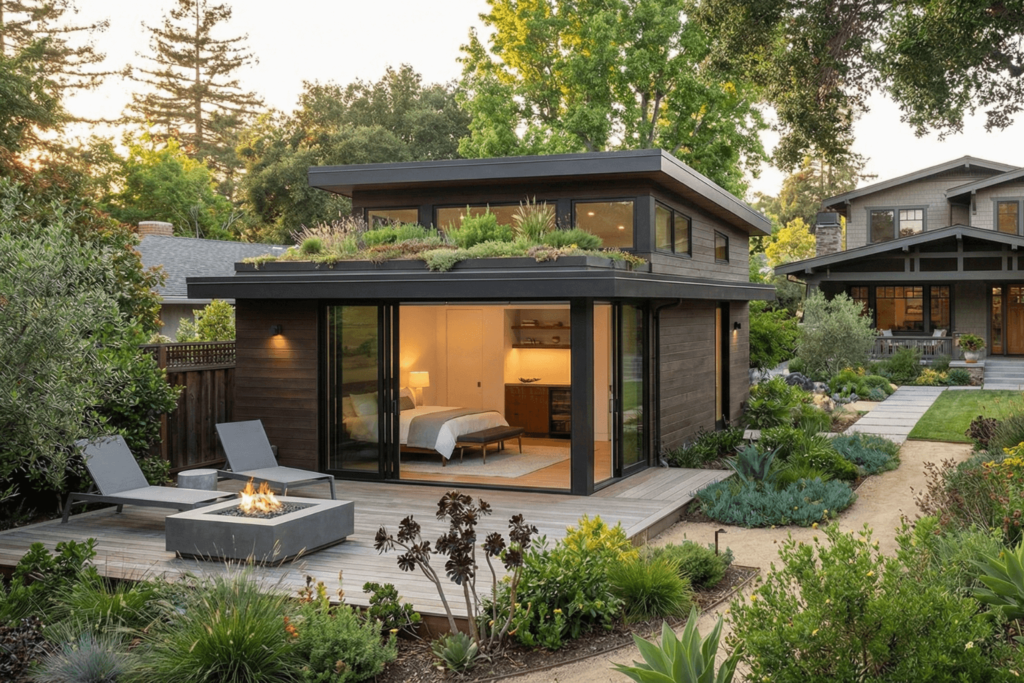
Defining Best Value ADU Contractors Los Angeles (Spoiler: It's Not About Being Cheap)
Here’s where we need to have a grown-up conversation about value versus price.
The best value ADU contractors Los Angeles can offer aren’t the ones racing to give you the lowest bid. They’re the ones who deliver quality that lasts, transparency that builds trust, and results that increase your property value by an average of 20-35% (according to 2026 LA real estate data).
What “Best Value” Actually Means:
Premium Materials = Long-Term Savings
Cheap materials are expensive. That bargain lumber? It’ll warp. That discount roofing? You’ll be replacing it in five years. We use materials built to withstand Southern California’s schizophrenic weather—105°F in September, torrential rain in February, perfect beach weather in January (thanks, climate change).
No Hidden Costs = No Trust Issues
Our proposals are itemized. Transparent. You know what you’re paying for and why. No surprise “Oh by the way, the thing we definitely should have mentioned will cost $15,000 extra” moments. In an era where contractor surprise costs have increased 31% year-over-year, we’re out here being predictably honest like it’s a radical concept.
Longevity > Quick Fixes
We’re building structures that will outlast your Netflix password. These aren’t garage conversions held together with hope and contractor-grade prayers. These are luxury guest houses, backyard cottages, and rental units engineered to the same standards as your main residence.
When you’re working with ADU contractors in Los Angeles who specialize in high-end projects, you’re not just adding square footage. You’re making an investment. In rental income (the average LA ADU rents for $2,400-3,200/month in 2026). In family flexibility. In property value. In having the coolest backyard in your neighborhood.
Why We Are the Most Trusted ADU Contractors in Los Angeles (And No, We're Not Just Saying That)
Okay, real talk: the construction industry has a bit of a reputation problem. We’ve all heard the horror stories. The contractor who takes your deposit and disappears like a magician. The “three-month project” that somehow stretches into year two. The surprise costs that pop up like those annoying ads you can’t skip.
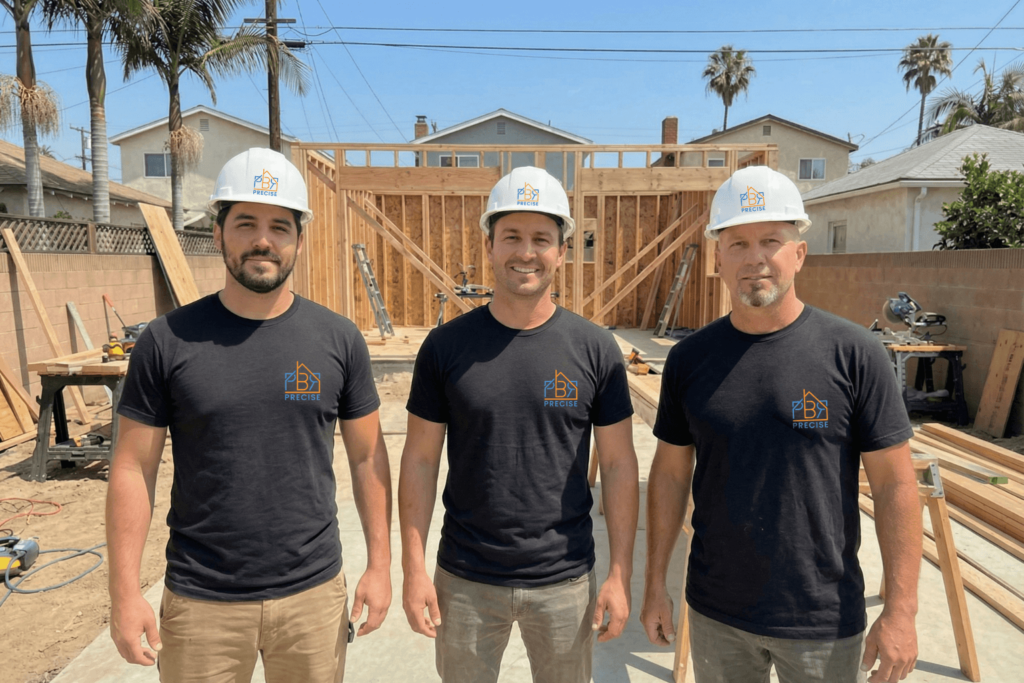
Here’s why we’re different, and why we’re considered the most trusted ADU contractors in Los Angeles:
35+ Years of Not Screwing This Up
As a trusted home builder in Los Angeles, we’ve been in the industry for over three and a half decades. That’s longer than most people’s marriages. (Sorry, not sorry—statistics don’t lie. The average US marriage lasts about 19 years in 2026.) For the past 15+ years specifically, we’ve been laser-focused on building our reputation for precision, one project at a time.
Family-owned businesses don’t survive that long by cutting corners or ghosting clients. We survive because word-of-mouth in Southern California’s tight-knit luxury home market is everything. One unhappy client with expensive taste and a robust social network can tank you. One delighted client? They’ll sing your praises from their rooftop deck overlooking the Hollywood Hills.
We Actually Show Up
Revolutionary concept, we know. But in 2026, with contractor no-shows up 23% according to the National Association of Home Builders, this is apparently a superpower now. We communicate. We answer emails that aren’t just “???” from you wondering where we are. We deliver on timelines that don’t require a Ouija board to predict.
Your home is personal. It’s where your kids grew up, where you host Thanksgiving (and referee the inevitable political arguments), where you built memories. We get that. Which is why we treat every square inch like it’s going to be featured in Architectural Digest—because honestly, some of our work has been.
The Luxury Touch (Because Your Taste Isn't Basic and Neither Are We)
We know our clients. You’re not shopping at IKEA for entertainment. Your kitchen has appliances that cost more than some people’s cars. You’ve used the phrase “curated aesthetic” unironically, and honestly? We respect it.
Our projects reflect that. We’re talking:
- Flawless finishes that would make an interior designer weep tears of joy
- Cutting-edge smart home technology integration
- Custom details that show meticulous attention to every decision
- Structural safety that exceeds code requirements (because “good enough” isn’t in our vocabulary)
Whether it’s a modern farmhouse backyard cottage, a sleek contemporary rental unit, or a traditional Craftsman-style guest house, we build it like it’s going into a luxury home portfolio. Because it is.
Ready to Turn Your Backyard Into a Revenue Stream (Or Family Compound, Or Personal Paradise)?
Look, you didn’t make it this far in the article because you’re just casually curious. You’re ready. Ready to stop letting that space collect dust and start making it work for you. Ready to work with ADU contractors Los Angeles homeowners actually recommend to their friends.
Ready to partner with a team that’s been doing this longer than some of our competitors have been alive.
Here’s what happens next:
Call (818) 477-5454 – and let’s schedule your free in-home estimate. We’ll walk your property, listen to your vision, and create a plan that actually makes sense for your goals, your budget, and your timeline.
Remember: Your first three designs are on us. No obligations. No pressure. Just possibilities.
Because at Precise Building & Restoration, we believe every homeowner deserves contractors who show up, communicate, and deliver. Revolutionary concepts in 2026, apparently, but we’ve been doing it for 35+ years.
Your backyard goldmine is waiting. Let’s dig in.
Precise Building & Restoration
Excellence. Precision. Integrity.
Serving Los Angeles County’s most discerning homeowners since before it was cool.
Frequently Asked Questions
How much does it actually cost to build an ADU in 2026?
ADU construction costs in 2026 range from $80,000 to $750,000+ depending on type and location. In Los Angeles and Southern California, expect $250-$450 per square foot for quality construction.
Breakdown by type:
- Garage conversions: $80,000-$150,000 (most affordable option)
- One-bedroom detached ADU: $180,000-$280,000
- Two-bedroom ADU: $250,000-$380,000
- Two-story ADU: $320,000-$480,000
- Luxury custom ADU: $500,000-$750,000+
Additional costs beyond construction: Permits ($8,000-$25,000), architectural plans ($8,000-$20,000), utility connections ($5,000-$15,000), site preparation ($10,000-$35,000), and landscaping ($5,000-$25,000).
ROI consideration: ADUs typically increase property value by 20-35% and generate $2,400-$3,200 monthly rental income in Los Angeles markets.
How long does it take to build an ADU from start to finish?
The complete ADU timeline ranges from 9-18 months in California, with significant variation based on project type and local jurisdiction.
Phase breakdown:
- Permit approval: 2-6 months (despite California’s 60-day rule, the clock starts only after completeness check)
- Design and planning: 1-3 months
- Construction: 5-9 months for new builds, 3-4 months for garage conversions
- Pre-fab/modular ADUs: 8-12 weeks construction time (but same permitting timeline)
What causes delays: Incomplete permit applications, utility company approvals (especially PG&E in Northern California), site condition issues, and jurisdictional complexity in hillside or coastal zones.
2026 improvement: New California laws (AB 543) require 15-day initial completeness checks, tightening timelines.
Can my HOA stop me from building an ADU?
No. California state law (effective 2020) prohibits Homeowners Associations from preventing ADU construction on single-family residential properties.
Important details:
- HOAs cannot use CC&Rs (Covenants, Conditions & Restrictions) to block ADUs
- HOAs may still have some design review authority for aesthetic standards
- This protection applies statewide, overriding local HOA rules
- Multifamily properties have different regulations under SB 1211
What HOAs can do: Request adherence to architectural guidelines for exterior appearance, but cannot deny the project entirely.
Recommendation: Notify your HOA early and work collaboratively on design elements to avoid friction.
Do I need to live on the property if I build an ADU?
No owner-occupancy requirement currently exists in California for ADUs. The state suspended this requirement, and as of 2026, you can rent both your primary residence and ADU without living on the property.
Exception: Junior ADUs (JADUs) still require owner occupancy in either the main house or the JADU unit itself.
Rental flexibility: You can:
- Rent the ADU while living in the main house
- Rent the main house while living in the ADU
- Rent both structures without occupying either
- Use the property purely for investment purposes
Future consideration: This waiver was extended multiple times; check current regulations if building after 2027.
Will building an ADU increase my property taxes?
Yes, but only on the added value of the ADU itself, not your entire property. In California, Proposition 13 protects against full property reassessment.
How it works:
- Your property tax increases only on the supplemental value added by the ADU
- The main house assessed value remains unchanged
- Average property tax increase: $1,500-$4,000 annually depending on ADU value
- This is offset by rental income potential ($28,800-$38,400 annually)
Example calculation: A $300,000 ADU adds approximately $3,000/year in property taxes (at 1% base rate), while generating $36,000/year in rental income.
Additional benefit: The increased property value (20-35% boost) benefits you at resale.
Can I rent my ADU on Airbnb or only for long-term rentals?
It depends on your city’s regulations. Long-term rentals (30+ days) are permitted statewide in California, but short-term rental rules vary by jurisdiction.
Long-term rentals (30+ days):
- Permitted in all California cities
- Easiest to manage with stable income
- One-year leases most common
Short-term rentals (under 30 days):
- Some cities prohibit ADUs from short-term rental use
- Cities like Los Angeles, San Francisco, and San Diego have specific restrictions
- Some jurisdictions require special permits or registration
- Revenue potential: $150-$300/night in desirable neighborhoods (50% occupancy = $2,250-$4,500/month)
Before deciding: Check your specific city’s short-term rental ordinances and any HOA restrictions.
Do I need separate utilities for my ADU?
Separate utility meters are not required in California, but are optional based on homeowner preference.
What the law says:
- ADUs can share existing utility connections with the main house
- No requirement for separate gas, electric, or water meters
- Most homeowners keep shared utilities for simplicity and cost savings
When separate meters make sense:
- Renting to tenants and want them to pay utilities directly
- Local utility company requires upgrade anyway
- Investment property where you want clear expense separation
Alternative approach: Use sub-metering devices ($100-$300) to track ADU utility usage and bill tenants accordingly, or include utilities in rent price.
Cost consideration: Separate meter installation adds $5,000-$15,000 to project budget.
What's the difference between an ADU and a JADU?
A Junior ADU (JADU) is a smaller, more restricted type of accessory unit created within the existing primary residence, while an ADU can be detached, attached, or converted from existing structures.
JADU specifications:
- Maximum 500 square feet
- Must be located inside existing primary residence
- Can be created from bedroom or other interior space
- Requires owner occupancy (in either main house or JADU)
- Can have efficiency/kitchenette instead of full kitchen
- Often shares bathroom with main house
ADU specifications:
- Up to 1,200 square feet (detached) or 50% of main house size (attached)
- Can be fully detached, attached, or garage conversion
- Requires full kitchen, bathroom, sleeping area
- No owner-occupancy requirement
- More expensive but more versatile
Key advantage of JADUs: Lower cost ($25,000-$75,000), faster permitting, minimal impact fees.
Will I need to upgrade my electrical panel for an ADU?
Most likely yes. Electrical panel upgrades are one of the most common “surprise” costs in ADU projects, affecting approximately 60-70% of builds.
Common scenario:
- Older homes typically have 100-amp electrical service
- ADUs require upgrading to 200-amp service to safely handle additional load
- Cost: $3,000-$8,000 for panel upgrade
Signs you’ll need an upgrade:
- Your home has a 100-amp or smaller panel
- Built before 1980
- Planning electric heating, cooling, or appliances in ADU
- Existing panel is at capacity
Who pays: Homeowner responsibility, but some utility companies offer rebates for electrical upgrades.
Can I sell my ADU separately from my main house?
In some California cities, yes. AB 1033 (effective January 2024) allows ADUs to be sold as separate condominiums, but only if your local jurisdiction has adopted enabling ordinances.
Cities that currently allow ADU condo sales:
- San Jose
- Santa Monica
- San Diego
- Several others (check your specific city)
How it works:
- Property must be “condo-mapped” to create separate legal parcels
- Each unit gets its own deed and can be sold independently
- Creates homeownership opportunities in expensive markets
- Useful for estate planning or accessing equity
Limitations:
- Not available in all jurisdictions (most cities haven’t adopted ordinances yet)
- Legal and surveying costs to subdivide property
- HOA implications if applicable
- Title and mortgage considerations
Alternative: If selling separately isn’t allowed, the ADU increases your overall property value significantly when selling the entire property.
Note: This is rapidly evolving legislation; more cities are expected to adopt enabling ordinances through 2026-2027.